
Graphic EQ
Key Features
- Dynamic filter bandwidth that narrows on boost and tightens further on cut, emulating proportional-Q analog hardware behavior
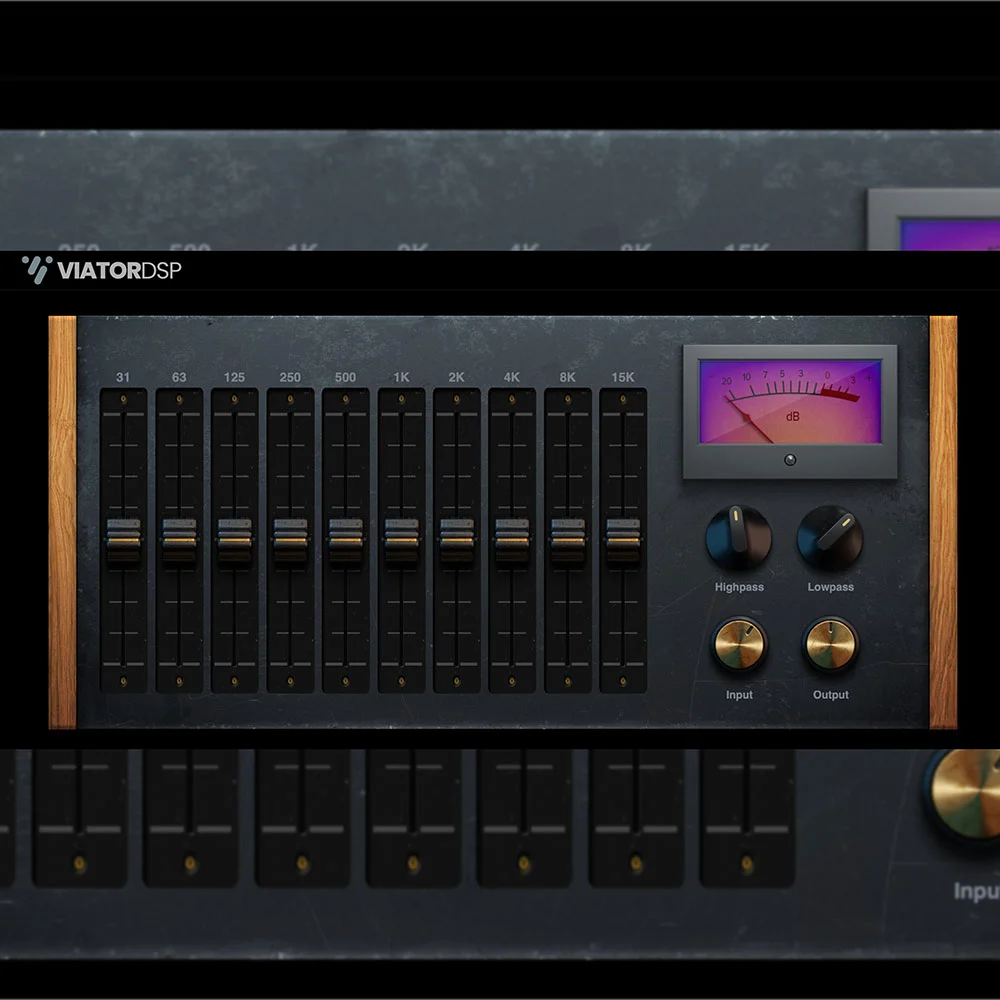
- 10 bands of equalization spaced at octave intervals across the full frequency spectrum for musical tone shaping
- Built-in highpass and lowpass filters for eliminating rumble and taming harsh high-frequency content
- Real-time VU meter providing accurate visual feedback during mixing and gain staging
- Dedicated input and output controls for transparent gain staging throughout the signal chain
- Analog-modeled processing that captures the character of vintage hardware EQs with moderate CPU usage
Description
Graphic EQ by ViatorDSP is a 10-band analog-emulation equalizer that brings dynamic hardware behavior into your DAW. Rather than applying static digital boosts and cuts, its filter bandwidth responds to gain changes — narrowing as you boost for a harmonically pleasing, organic sound and tightening further on cuts for surgical precision without removing excess signal.
The ten fixed bands are spaced at octave intervals across the full frequency spectrum. This deliberate constraint encourages musical decision-making over technical tweaking, letting you shape tone in broad, natural strokes.
Built-in highpass and lowpass filters handle cleanup duties, rolling off unwanted rumble or taming harsh high-frequency content. Input and output level controls paired with a real-time VU meter keep your gain staging transparent throughout the signal chain.
The dynamic filter bandwidth is what sets this plugin apart from typical graphic EQs. It emulates the proportional-Q behavior found in classic hardware units where bandwidth and gain are interdependent, producing results that sound more musical and less clinical.
Available as VST3 and AU for both Windows and macOS, Graphic EQ runs with a moderate CPU footprint despite its analog-modeled processing.
Video Preview

Frequently Asked Questions
How does the dynamic filter bandwidth in Graphic EQ differ from a standard graphic EQ?
Unlike static digital graphic EQs where the bandwidth stays constant regardless of gain, Graphic EQ's bandwidth narrows as you boost and tightens even further when you cut. This proportional-Q behavior mirrors classic analog hardware, producing smoother boosts and more precise cuts without removing too much signal.
Can Graphic EQ be used for surgical mixing tasks or is it mainly for broad tonal shaping?
While the fixed 10-band layout is designed for broad, musical tone shaping rather than pinpoint surgical work, the dynamic bandwidth behavior gives cuts a tighter focus than typical graphic EQs. For highly surgical tasks like notching out specific resonances, a parametric EQ would be more appropriate.
Does Graphic EQ add analog coloration or is it transparent?
Graphic EQ is designed to emulate the character of analog hardware, so it does impart subtle coloration rather than operating as a fully transparent digital EQ. The dynamic bandwidth and analog modeling add warmth and harmonic richness that many producers find musical and pleasing on a variety of source material.


