Jerrican
Key Features
- Four coordinated granular voices cover bass, pads, haze-like texture, and harmonically locked keys.
- Press Play after setting ranges to generate a new evolving piece instead of programming every note.
- Evolution lets individual controls drift over time for hands-off motion and changing texture.
- A global Mode control supplies 21 scales so independently moving voices remain tonally connected.
- Factory presets and a user preset library provide repeatable starting points for new generative setups.
- AU and VST3 hosts can route each voice to its own DAW channel while keeping a shared clock.
- Full MIDI Learn and host sync make the instrument practical alongside controller and DAW workflows.
Description
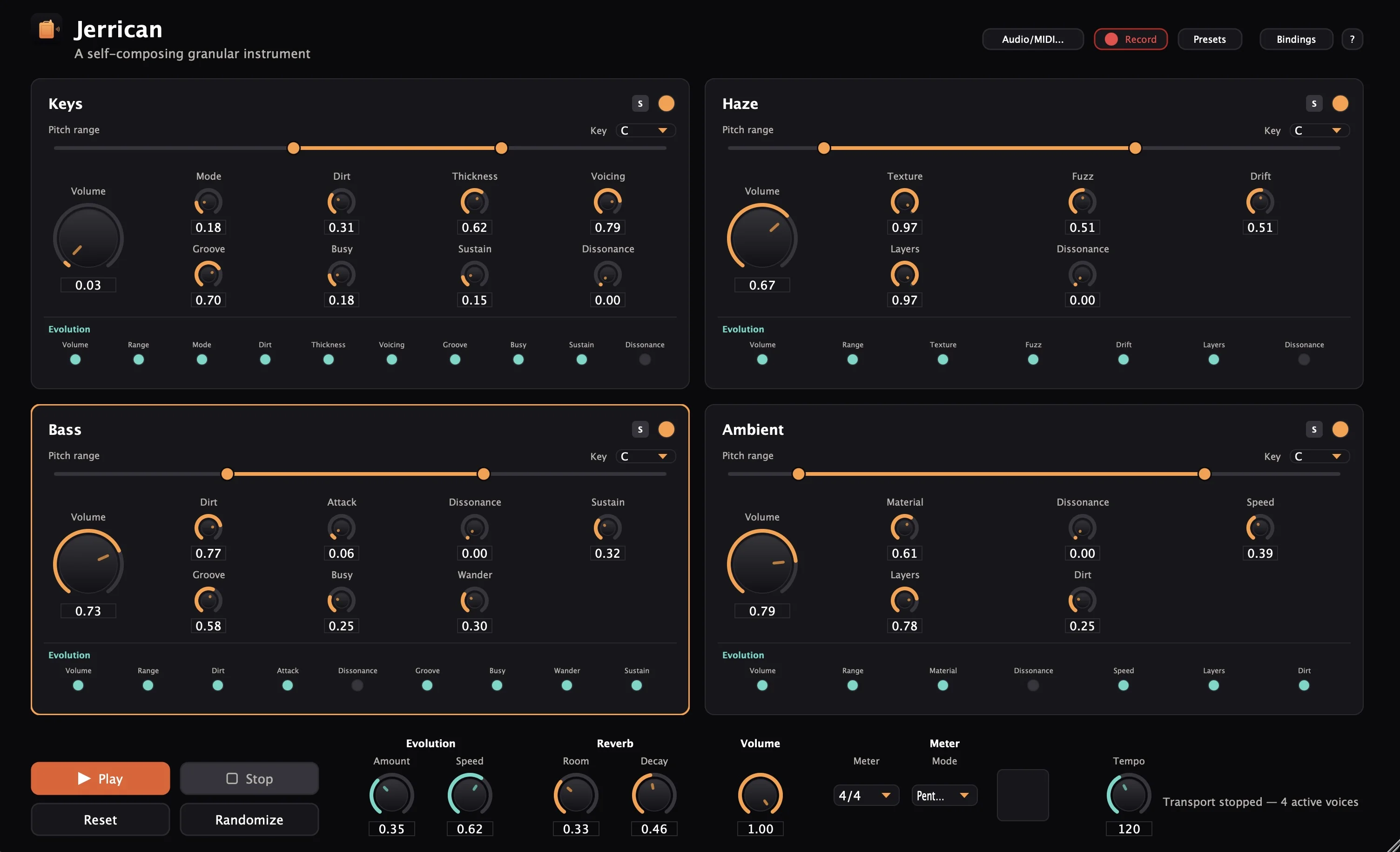
Jerrican is a self-generating granular instrument by Alban Bailly's Alioso project. Rather than waiting for MIDI notes, it continuously creates an evolving four-part arrangement from overlapping micro-grains after you set its ranges and press Play.
The Bass, Ambient, Haze, and Keys voices have distinct musical jobs: a metered bass line, slowly changing pad, grainy texture layer, and harmonically connected chord part. This makes it a compact source of moving beds and musical sketches instead of a conventional preset synth.
An Evolution system can let individual controls drift over time, adding change without constant automation. Its global Mode setting offers 21 scales, so all four voices can develop independently while remaining in the same tonal framework.
Jerrican also includes factory and user preset support, MIDI Learn, host sync, and separate DAW outputs for each voice in AU and VST3 hosts. That routing is useful when an initially generated arrangement turns into material you want to balance, process, or arrange further.
The instrument runs standalone as well as in compatible macOS and Windows DAWs. Its developer distributes the full version through a $0+ Gumroad page with an optional €15 donation, so the download route remains permanently accessible without a paid feature tier.
Frequently Asked Questions
Does Jerrican need MIDI notes to make sound?
No. Jerrican is designed to begin generating when you set its ranges and press Play, rather than requiring a traditional note-performance input. MIDI Learn and host sync are available for controlling it in a DAW or with hardware.
What do the four voices do?
Bass supplies a metered walking part, Ambient supplies a slowly changing pad, and Haze provides a grittier texture layer. Keys adds chordal material that stays harmonically connected to the other voices.
Can I mix Jerrican's generated parts separately?
Yes. In AU and VST3 hosts, each voice can be sent to its own DAW track while sharing the same clock. This lets you process and balance the four generated roles independently.
Will a saved setup repeat exactly?
No. The developer describes Jerrican as continuously reshaping overlapping micro-grains, so the same settings can produce a different piece each time. Save presets when you want to recall the same boundaries and controls rather than an identical performance.