
Lens
Key Features
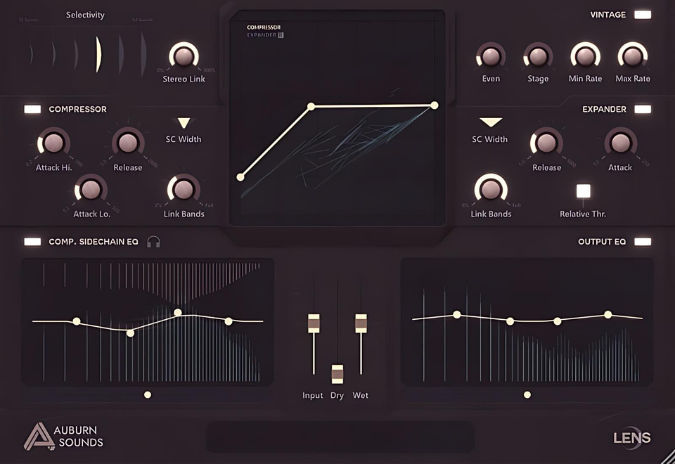
- Up to 64 compression bands operating in the spectral domain without phase shifting at crossover frequencies
- Constant-phase sidechain EQ and output EQ with no ringing artifacts for transparent tonal shaping
- Built-in Vintage saturation section with adjustable Even, Stage, Min Rate, and Max Rate parameters
- Clean upwards compression mode for bringing out detail and presence without harsh artifacts
- Spectral masking removal that suppresses information hidden by nearby frequency components
- Simultaneous control of sidechain EQ and output EQ curves in a single unified interface
- Cross-platform support with CLAP, VST2, VST3, AU, AAX, LV2, and FLP formats on Windows, macOS, and Linux
Description
Lens by Auburn Sounds is a spectral dynamics processor that approaches multiband compression from a fundamentally different angle. Rather than splitting the signal at fixed crossover points, it operates in the spectral domain with up to 64 compander bands working simultaneously on a stereo signal.
Originally designed as a mastering compressor, the prototype revealed itself as something far more versatile. It handles track compression, auto-EQ, noise removal, upwards compression, and multiband expansion/gating, earning its name from the "spherical" character it imparts.
The sidechain EQ and output EQ both use constant-phase filtering without ringing artifacts, letting you shape the compression response and final tone in a single interface. A built-in Vintage section adds saturation with adjustable intensity and band range control for analog warmth.
Lens introduces 54 ms of latency and draws more CPU than a typical compressor, but the tradeoff is extraordinary spectral control. Users consistently praise its ability to tame boxy low-mids on vocals and add punch to full mixes with minimal effort.
The included cheat sheet helps navigate the spectral domain workflow, which differs from traditional multiband compressors. Lens is available as a VST2, VST3, AU, AAX, LV2, and CLAP plugin for Windows, macOS, and Linux.
Video Preview


Frequently Asked Questions
What is the difference between Lens Free and Lens Full?
Lens Free includes all compression features, sidechain EQ, output EQ, and the Vintage saturation section. The only difference is that the Full edition ($49) adds the Expander section for multiband expansion and gating.
How much latency does Lens introduce?
Lens introduces a fixed 54 ms of latency, which is required to maintain bass alignment in the spectral domain. This makes it best suited for mixing and mastering rather than live monitoring, and your DAW's plugin delay compensation will handle it automatically.
What should I use multiband compression on?
Multiband compression works well on the master bus for gluing a mix together, on vocals for taming resonant frequencies without affecting the rest of the signal, and on bass instruments for controlling boomy low-end notes. Lens is particularly effective at suppressing boxy low-mids on vocal recordings.
How does Lens compare to traditional multiband compressors?
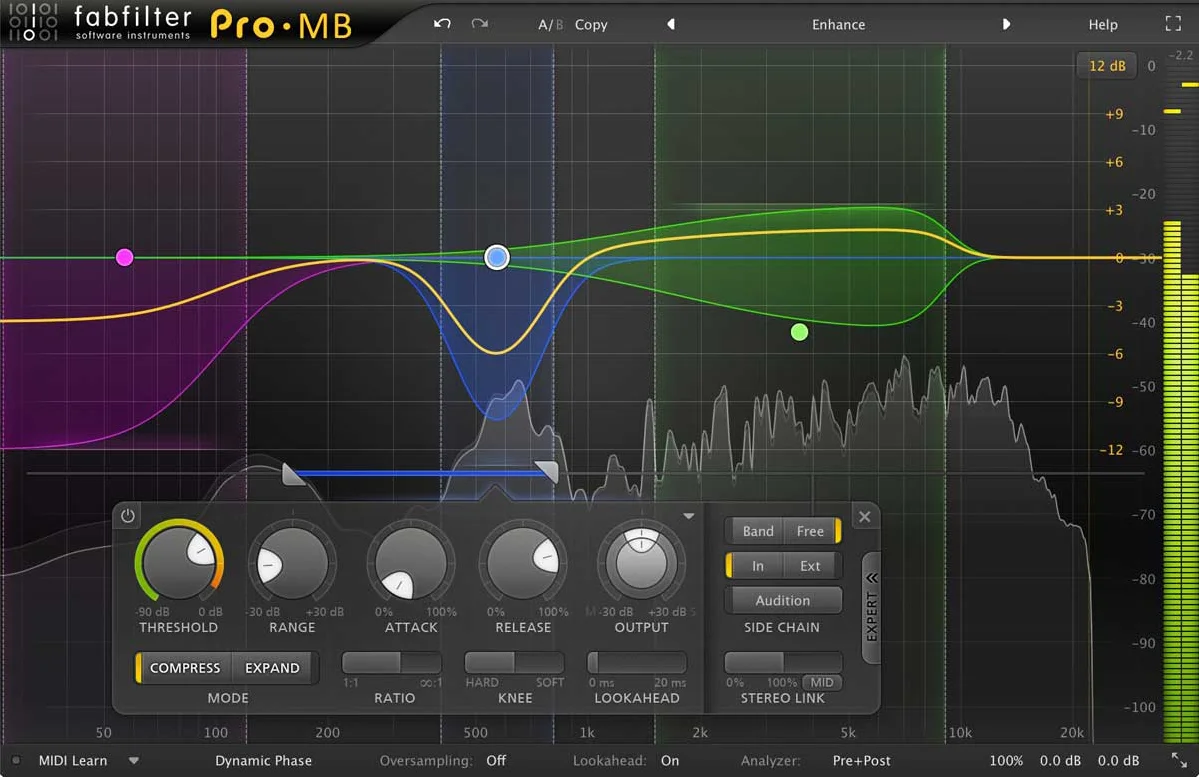
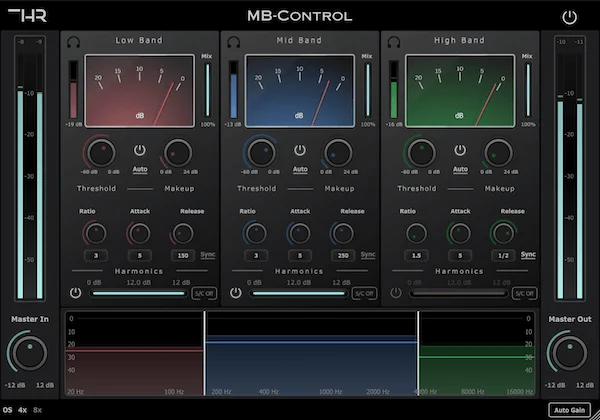
Unlike conventional multiband compressors that split the signal at fixed crossover points, Lens operates in the spectral domain with up to 64 bands. This eliminates phase shifting at crossover frequencies and provides much finer-grained control, though it comes with higher CPU usage and a constant phase-shift tradeoff.


