
MAutoPitch
Key Features
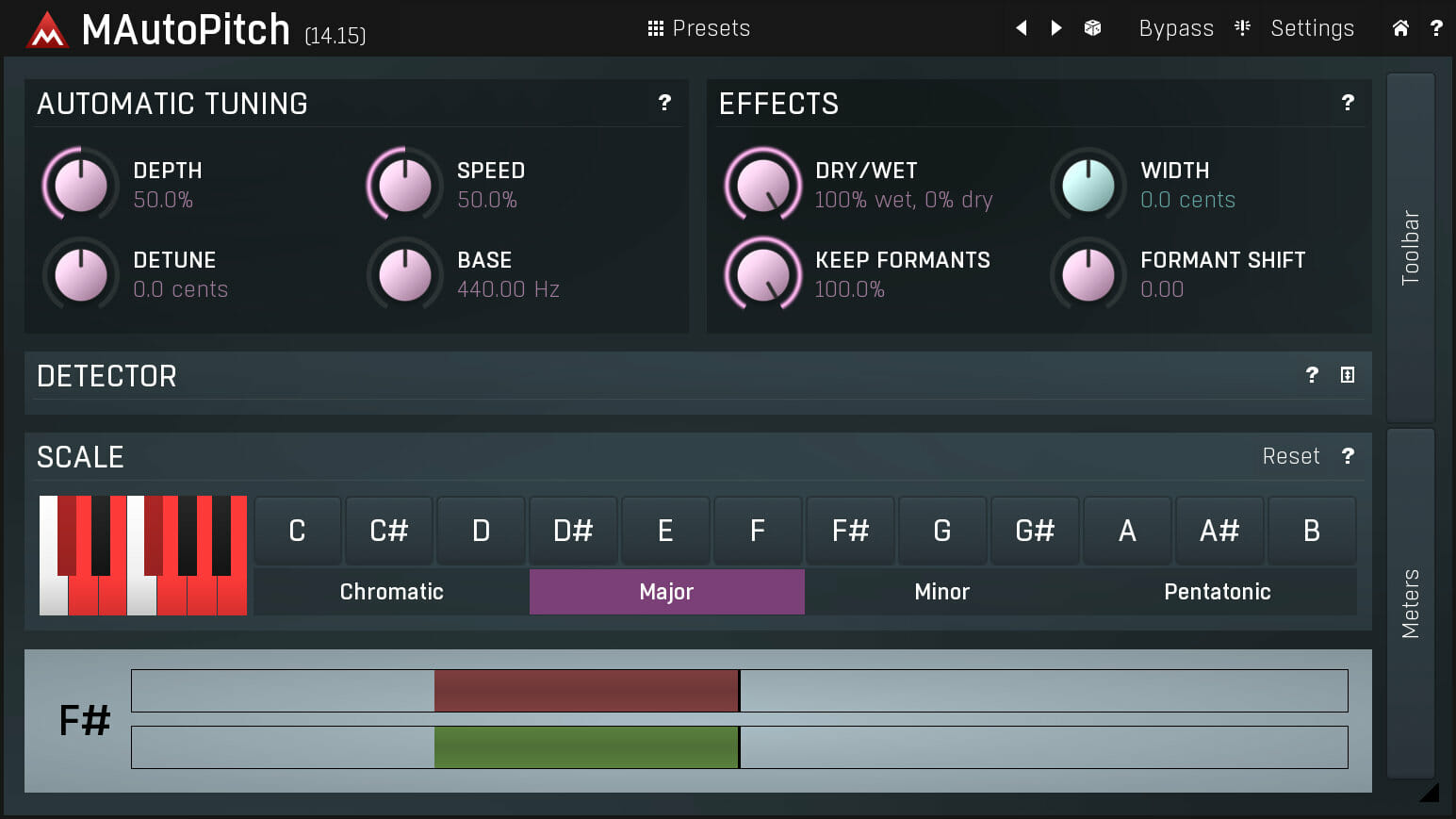
- Depth controls correction accuracy, from tolerated deviation to exact tuning
- Speed sets how quickly correction follows changed notes
- Scale panel restricts correction to selected notes or the current song scale
- Detune and Base frequency controls for global pitch reference
- Keep formants helps preserve a more natural spectral envelope
- Formant shift changes vocal or instrument character independently
- Threshold, Stabilization, and Min/Max frequency controls refine detection
Description
MAutoPitch is an automatic pitch-correction plugin for vocals and other monophonic instruments, with controls for natural movement or hard tuning. Depth determines how closely the output follows the target note: at 100% it usually sounds machine-like, while lower values allow more deviation.
Speed controls how quickly correction follows a changed note, with faster settings producing less natural transitions. The Scale panel lets you restrict correction to selected notes or a basic scale preset; its default chromatic setting allows all 12 semitones.
Detune shifts the global pitch in cents, while Base frequency changes the tuning reference from the usual 440Hz when needed. Keep formants tries to preserve the voice or instrument's tonal character during pitch shifting, while Formant shift deliberately changes that character without generally shifting the note itself.
The pitch detector also has controls for difficult material, so a noisy gap or an abrupt change does not have to dictate the correction. Threshold excludes low-level sections, Stabilization slows larger pitch changes, and Min/Max frequency narrow the range the detector analyzes.
Video Preview

Frequently Asked Questions
Why does the tuning sound robotic?
The manual says 100% Depth usually sounds machine-like, and higher Speed can produce less natural results. Lower Depth and a less aggressive Speed setting allow more pitch deviation and gentler transitions.
How can I prevent wrong note detection?
Use Threshold to exclude quiet, noise-like gaps, then adjust Min frequency and Max frequency so the detector analyzes the useful range of the source. Stabilization can also slow abrupt pitch changes in complicated material.
How do I keep correction inside my song's key?
Open the Scale panel and enable only the notes allowed in the current scale, either manually or with a basic scale preset. The default chromatic scale allows all 12 semitones, so it must be narrowed when scale-aware correction is wanted.
What is the difference between pitch correction and Formant shift?
Pitch correction moves the detected note toward the target, while Formant shift changes formant information in semitones and generally does not shift pitch by itself. Keep formants is a separate control that attempts to reduce spectral-envelope changes during pitch shifting.


