
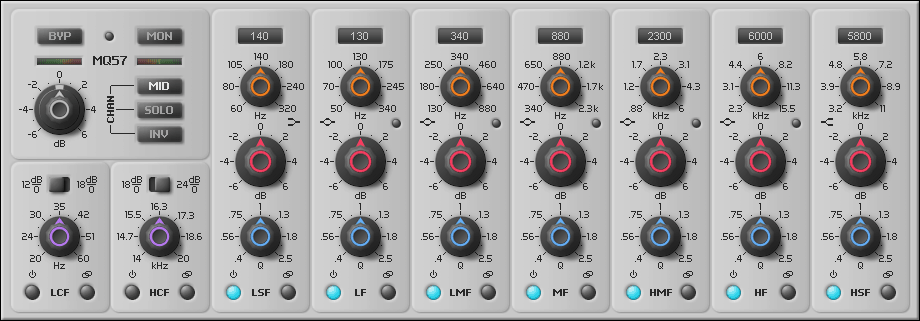
MQ57
Key Features
- Seven parametric minimum-phase filters per channel with five peak and two shelving bands optimized for mastering-level precision
- Mid/Side and Left/Right dual-mono processing lets you EQ the center and sides of a stereo image independently
- Dedicated spectrum tilt control adjusts overall brightness or warmth in a single move
- High-pass and low-pass filters with slopes chosen to preserve natural sound at the frequency extremes
- Channel balance control for correcting stereo level imbalances during mastering
- Zero-latency processing with 32-bit internal precision and no introduced harmonic or dynamic distortion
- Low CPU consumption suitable for running multiple instances across a mastering session
Description
MQ57 is a parametric equalizer built specifically for mastering workflows. Developed by Jovan Iljadica under the J1000 label, it provides seven minimum-phase filters per channel with five peak bands and two shelving bands, all tuned toward broad tonal adjustments rather than surgical cuts.
Every control has been deliberately constrained for mastering-appropriate ranges. Q factors stay wide to shape overall spectral balance, gain ranges remain moderate for fine-tuning, and dedicated high-pass and low-pass filters handle spectrum extremes without overshooting.
The plugin operates in stereo or dual-mono mode with full Mid/Side or Left/Right channel selection on each filter. A built-in tilt control adjusts the overall spectral slope, and a balance control lets you offset channel levels for precise stereo correction.
Processing runs at 32-bit internal precision with zero latency and minimal CPU load. MQ57 introduces no harmonic coloring or dynamic distortion, delivering transparent equalization where what you dial in is exactly what you hear.
Users consistently praise MQ57 for the clarity it adds to masters. Its effects are intentionally subtle, making it well suited as a finishing EQ once the heavy lifting has already been done by more aggressive processors earlier in the chain.
Frequently Asked Questions
What makes MQ57 different from a standard parametric EQ?
MQ57 has all its Q factors, gain ranges, and filter slopes specifically constrained for mastering rather than mixing. The Q stays intentionally wide for broad tonal shaping, and gain ranges are moderate to prevent over-processing. This means you cannot make extreme surgical cuts, but the trade-off is that every adjustment sounds natural and musical at the mastering stage.
How does the Mid/Side processing work in MQ57?
Each of the seven filter bands can operate independently on the mid (center) or side (stereo width) channels. This lets you brighten only the sides for a wider feel or tighten the bass in the center without affecting the stereo image. You can also switch to Left/Right mode for traditional dual-mono operation.
Is MQ57 transparent enough for mastering, or does it color the sound?
MQ57 is designed to be completely transparent. It uses minimum-phase filters with no deliberate harmonic distortion, saturation, or analog emulation. What you dial in is exactly what you get, making it well suited for mastering where preserving the mix character is essential.


