
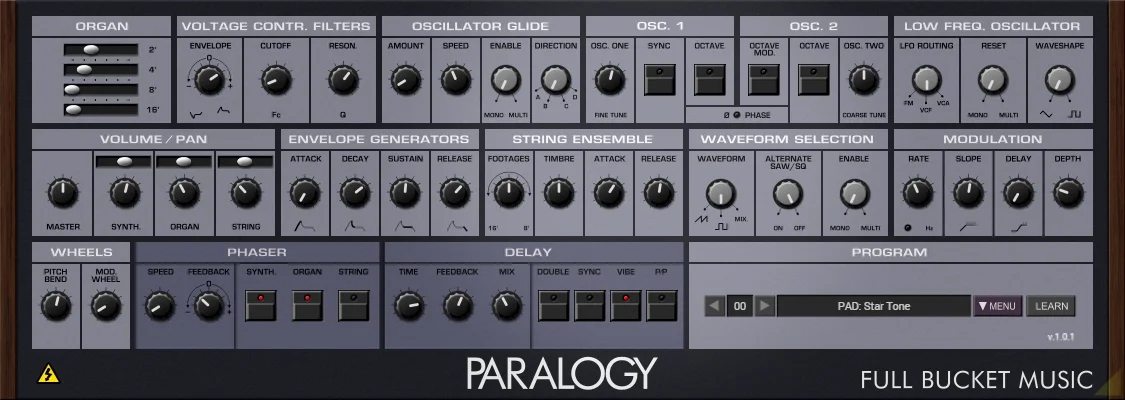
Paralogy
Key Features
- Closely recreates the Crumar Trilogy and Stratus voice behavior, including the unusual pitch-class voice assignment that gives chords and retriggers their signature paraphonic personality
- Combines organ, synthesizer, and string ensemble sections in one instrument, so layered vintage textures come together inside a single plugin window instead of across multiple patches
- Uses dual divide-down oscillators with detune, sync, octave switching, and glide controls for phase-locked retro tones that can move from silky to unstable very quickly
- Built-in phaser and bucket-style delay expand the raw hardware concept into something easier to place in synthwave, ambient, soundtrack, and library-style productions
- Resizable interface in the main builds plus full MIDI Learn keep a historically quirky instrument practical in modern hands-on DAW workflows
- Native C++ implementation, current CLAP and AAX support, and Universal Binary 2 Mac packages keep CPU use light while covering modern plugin formats
Description
Paralogy is a software emulation of the Crumar Trilogy and Stratus, two early-1980s Italian keyboards built around an unusual paraphonic architecture. Full Bucket Music turns that design into a modern plugin with organ, synth, and string sections, so it lands less like a generic vintage polysynth and more like a focused divide-down ensemble machine with its own quirks.
The character comes from how the original hardware handled voices. Notes are hard-wired to six voice paths by pitch class, so certain note combinations can retrigger one another in ways that feel slightly unstable but musically alive, while the divide-down oscillators keep octaves phase-locked for that unmistakably old-school sheen.
Paralogy stays appealing because Full Bucket did not stop at straight preservation. You get the original multi-section layout, modern resizing, full MIDI learn, and built-in phaser and delay, which makes it easier to turn the instrument into lush retro pads, wiry organ layers, or strange library-synth textures without leaving the plugin.
It is not the broadest synth in the world, and that is part of the point. MusicRadar noted that it favors pleasantly retro sounds over endless versatility, and early user reactions on Gearspace praised the usable presets plus the internal phaser and delay, which fits Paralogy best as a character instrument for producers who want vintage color fast rather than a blank-canvas flagship synth.
Video Preview


Frequently Asked Questions
What vintage keyboards does Paralogy emulate?
Paralogy is based on the Crumar Trilogy and Stratus keyboards from the early 1980s. Full Bucket Music describes it as a close software simulation of those instruments rather than a loose vintage-inspired synth.
Why does Paralogy feel different from a normal polysynth?
Its voice handling follows the original Crumar design, where notes are hard-wired to six voice paths by pitch class instead of being allocated by a computer. That means some note combinations can retrigger each other and create the quirky para-polyphonic behavior the manual spends a lot of time explaining.
Does Paralogy add anything beyond the original hardware?
Yes. Full Bucket adds a built-in phaser and delay, a resizable interface in the standard builds, MIDI Learn for every parameter, and a few tweak controls such as sync phase, master tune, and release behavior. Those extras make it easier to use in a modern DAW without removing the original instrument's limitations.
Does Paralogy run natively on Apple Silicon Macs?
Yes. The current macOS CLAP, VST2/VST3/AU, and AAX downloads are listed as Universal Binary 2 builds for Intel and ARM Macs. The macOS page also includes separate non-resizable N builds for older systems if the standard package does not cooperate.
What is the difference between the standard and N versions?
The standard releases are the resizable builds that Full Bucket currently recommends. The N versions are described as sound-identical fallback builds for older Windows or Mac systems, or for machines where the standard version does not work properly, but they use a non-resizable interface.


