
Polarity-Glue

Key Features
- Uses linked stereo feedback compression and a ratio-dependent knee for SSL-style bus cohesion.
- Pairs familiar Threshold, Attack, Ratio, and Release controls with Range and phase-matched parallel Mix blending.
- Provides a two-stage Auto Release for quick transient response with smoother recovery on dense material.
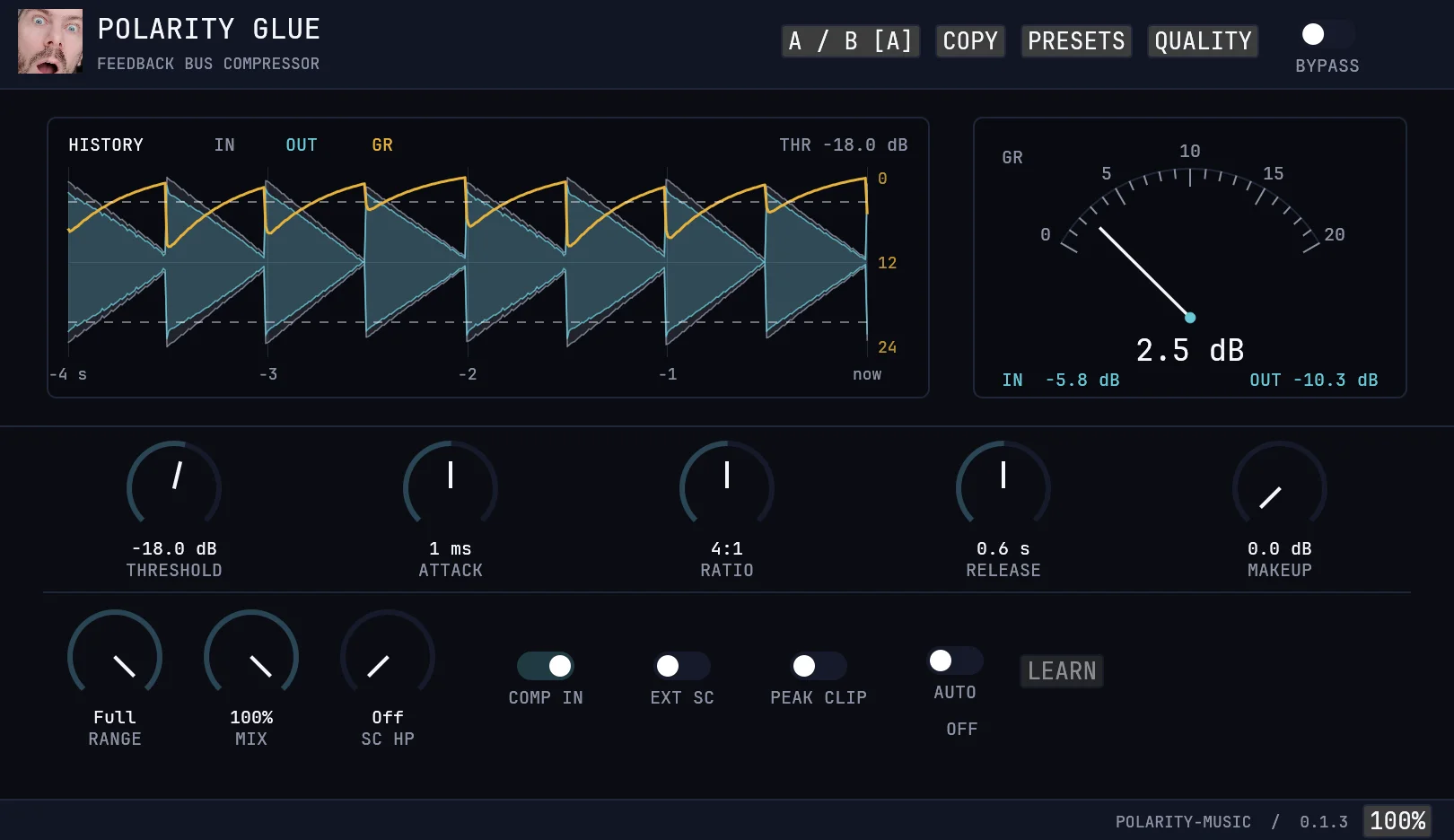
- Displays four seconds of input, output, threshold, and gain-reduction history to make envelope changes easier to see.
- Includes Auto Makeup, an external sidechain input, and a 20–2000 Hz detector high-pass filter for controlling low-end-driven pumping.
- Offers an optional output clipper and independent realtime or render quality from Off through 16x oversampling.
Description
Polarity-Glue is an SSL-inspired bus compressor for adding the shared gain movement that makes drum groups, instrument buses, and full mixes feel more connected. Its linked-stereo feedback detector and ratio-dependent knee are built for broad musical cohesion rather than surgical dynamics repair.
The main workflow stays familiar: set Threshold, choose Attack, Ratio, and Release, then use Range or the parallel Mix control to decide how far the envelope moves. A two-stage Auto Release can recover quickly from isolated hits while settling more smoothly over denser passages.
Polarity adds practical visual and finishing tools around that core compressor. Waveform history shows input, output, threshold, and gain reduction over the last four seconds, while Auto Makeup, an external sidechain, a 20–2000 Hz detector high-pass filter, and an optional output clipper make it easier to judge and refine the result.
Use lower ratios and modest reduction when a bus needs gentle glue, or drive the threshold further for more audible pumping. Up to 16x oversampling is available independently for playback and rendering, so higher-quality clipping and compression can be reserved for the final pass when CPU load and latency are less critical.
Frequently Asked Questions
What is Polarity-Glue designed to do?
It applies one shared gain envelope to a group or mix, helping separate parts move together. The official page positions it for drum buses, instrument groups, and full mixes where broad cohesion matters more than corrective, track-by-track control.
How does Auto Makeup work?
AUTO measures the compression loss over two seconds of audio and then holds the compensation amount. It is intended to make level-matched comparisons easier, rather than act as continuous gain riding or a loudness guarantee.
Can Polarity-Glue avoid bass-heavy pumping?
Yes. Its sidechain high-pass filter works from 20 to 2000 Hz, so low-frequency energy can be reduced in the detector path without filtering the audible bass. The compressor also accepts an external sidechain when another track should drive the gain reduction.
What does the waveform history show?
The history view shows the last four seconds of input and output waveforms, threshold guides, and measured gain reduction. It helps identify when compression begins, how much it removes, and whether the release is recovering between hits.


