Protoverb
Key Features
- Resonance-based room simulation that models the body of air rather than wall reflections, producing natural-sounding reverberation
- Over 50 interconnected delay lines create complex room behaviors where instruments remain distinct instead of blurring together
- Two randomize buttons generate unique reverb characters and delay structures for fast sound exploration
- User-entered text strings seed the randomization engine, allowing precise recall of discovered settings
- Ghost echo effect reproduces melodic fragments in the reverb tail, mimicking the acoustic behavior of churches and concert halls
- Native Apple Silicon support with cross-platform availability on macOS, Windows, and Linux
- Ships with 15 factory presets covering a range of room sizes and reverb characters
Description
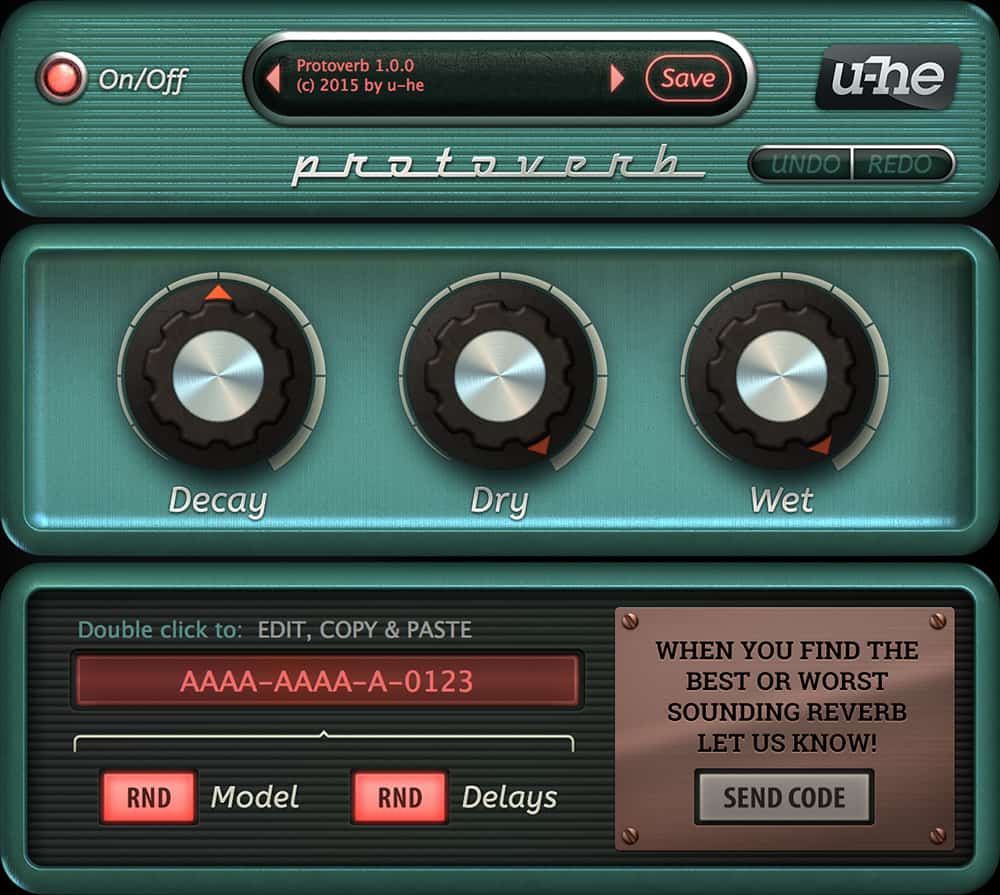
Protoverb by u-he is an experimental room simulator reverb that takes a fundamentally different approach to reverberation. Instead of modeling wall reflections like most algorithmic reverbs, it builds up as many room resonances as possible to simulate the body of air inside a space.
This resonance-based architecture produces some distinctive acoustic behaviors. Notes held for longer periods build up resonance gradually, as if the air itself needs time to become excited.
Multiple instruments remain distinct in the reverb tail rather than collapsing into a diffuse wash. Short melodic phrases produce ghost-like echoes that mimic how sound behaves in large churches and concert halls.
Protoverb uses a network of more than 50 parallel, serial, and interconnected delay lines to achieve its sound. The interface is deliberately minimal, offering just three main parameters (decay time, wet level, and dry level) alongside two randomize buttons that generate entirely new reverb characters and delay structures.
Released as "researchware," u-he designed Protoverb as a community experiment where users submit their best and worst presets to help develop future reverb algorithms. The plugin ships with 15 factory presets and supports user-entered text strings that seed the randomization engine.
Protoverb runs natively on Apple Silicon and is available for macOS, Windows, and Linux in VST2, VST3, AU, and AAX formats. CPU usage is higher than typical reverbs due to the dense delay network of 50-plus simultaneous delay lines.
Video Preview


Frequently Asked Questions
Why does Protoverb use more CPU than other reverb plugins?
Protoverb runs over 50 parallel and interconnected delay lines simultaneously to build up room resonances. This dense network architecture requires significantly more processing power than conventional algorithmic reverbs, which typically use far fewer delay lines.
How do the randomize buttons work in Protoverb?
The first button randomizes the reverb's sonic character by adjusting hidden internal parameters, while the second button randomizes the delay structure itself. You can also type a custom text string into the text box, which seeds the randomization engine and allows you to recall specific settings by re-entering the same string.
What is the purpose of sharing presets as researchware?
u-he released Protoverb as a community experiment to crowdsource knowledge about reverb design. By collecting user-submitted presets and feedback about what sounds good or bad, u-he gathers real-world data to inform the development of future commercial reverb algorithms.
Is AAX support available on macOS?
macOS AAX support is temporarily unavailable as of version 1.0.1. The current version of Avid's AAX toolkit is not compatible with the Apple SDK needed for Apple Silicon processors. AAX remains available on Windows for Pro Tools 10.3.7 or later.