Scyclone
Key Features
- Neural timbre transfer powered by RAVE variational autoencoder technology, transforming any audio input into a new timbral identity in real time
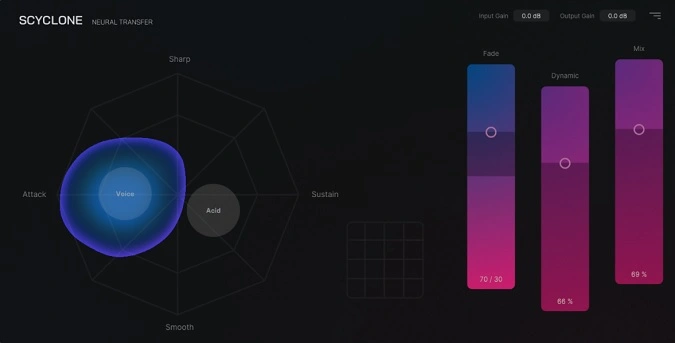
- Dual inference mode with X/Y pad control for blending two neural models between Attack, Sustain, Sharp, and Smooth sonic poles
- Two pre-trained models included: Funk Drums (vintage drum breaks) and Djembe (solo performances and one-shots)
- Full pre-processing chain with Transient Controller and Low-/High-Cut Filter to refine the input signal before neural processing
- Post-processing modules including Grain Delay for textural depth and Compressor for dynamic control of the output
- Open-source architecture (GPL 3) with support for loading custom ONNX models trained via the companion Scyclone-AI toolkit
Description
Scyclone by Torsion Audio is a neural timbre transfer plugin built on RAVE (Real-time Audio Variational Autoencoder) technology. It takes any incoming audio signal and transfers the tonal character of a trained neural network model onto it, producing hybrid textures that blend your source material with an entirely different sonic identity.
The plugin was developed by a team of audio programmers and machine learning engineers at TU Berlin, where it won first place in The Audio Programmer's Neural Audio Plug-in Competition. It operates in both single and couple inference modes, meaning you can run one neural model or blend two simultaneously through an intuitive X/Y pad.
Two pre-trained models ship with the plugin: Funk Drums, trained on four hours of vintage drum breaks, and Djembe, trained on five hours of solo performances and one-shot recordings. The X/Y pad lets you drag between four sonic poles -- Attack, Sustain, Sharp, and Smooth -- to sculpt how each model responds to your input.
Beyond the neural networks themselves, Scyclone includes a full signal processing chain for shaping results. Pre-processing modules include a Transient Controller and Low-/High-Cut Filter, while post-processing offers a Grain Delay for textural depth and a Compressor to glue the output together.
A Blend control crossfades between model outputs, giving you precise control over the final timbral balance.
Scyclone is open-source under GPL 3, and advanced users can train their own RAVE models using the companion Scyclone-AI repository, then load custom ONNX models directly into the plugin.
Video Preview


Tips
- Use the Transient Controller to fine-tune the attack and sustain of your drum loops for a more dynamic sound.
- Apply the Low-/High-Cut Filter to isolate specific frequency ranges and achieve a cleaner mix.
- Experiment with the Grain Delay to add unique textures and depth to your tracks.
- Utilize the Blend feature to seamlessly mix the outputs of different models for a richer sound.
- Load external ONNX models to expand the sonic possibilities and customize your timbre transfer.
- Use the X/Y pad to intuitively shape the sound by adjusting the balance between Attack, Sustain, Sharp, and Smooth settings.
- Combine the Funk Drums and Djembe models to create complex and interesting drum patterns.
Frequently Asked Questions
Can I train my own models for Scyclone?
Yes. Torsion Audio provides the Scyclone-AI repository with step-by-step instructions and Colab notebooks for training custom RAVE models. You need a dataset of audio (2-3 hours minimum), and training takes approximately three days on an RTX 3080. The exported ONNX model loads directly into the plugin.
How does the X/Y pad work?
The X/Y pad lets you position loaded models between four points: Attack (foreground emphasis), Sustain (underlying tone emphasis), Sharp (removes low frequencies), and Smooth (removes high frequencies). Dragging between these poles shapes how the neural network processes your audio in real time.
What types of audio does Scyclone work best with?
The included models are optimized for drums and percussion, but the underlying RAVE technology processes raw audio without assumptions, so any sound can be transformed. Users report good results with drum loops, atmospheric pads, and textured sound design material.