
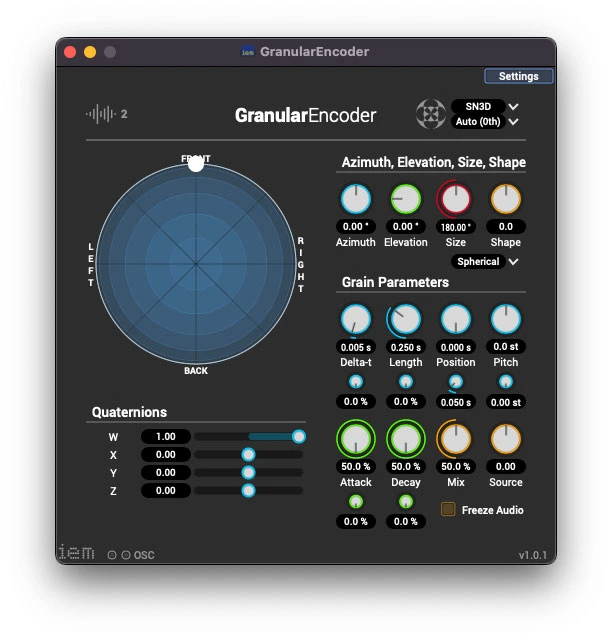
GranularEncoder
Key Features
- Encodes mono or stereo input into the Ambisonic domain.
- 2D circular and 3D spherical-cap grain distributions.
- Controllable center direction, size, and shape of the grain spread.
- Mix control for dry standard encoding, wet granular encoding, or blended grain-delay textures.
- Position and Source controls for seeding grains from the internal stereo buffer.
- Freeze mode for holding the buffer and creating sustained textures.
- Integrated modulators for variation in grain parameters.
Description
GranularEncoder is an open-source Ambisonic granular effect that turns mono or stereo input into spatial grains distributed around a controllable direction. Its 2D circular and 3D spherical-cap modes let you shape azimuth/elevation spread, while the Mix control blends dry standard encoding with wet granular encoding for either an Ambisonic granulator or a grain-delay style effect.
The internal stereo buffer provides Position and Source controls for choosing where grains are seeded and which channel supplies them. Freeze mode holds the buffer for sustained textures, and integrated modulators can add variation to timing and other grain parameters.
Frequently Asked Questions
What does GranularEncoder do?
It takes mono or stereo audio and encodes short grains into the Ambisonic domain. The grains are distributed around a chosen center direction, turning a source into a spatial granular scene.
What is the difference between the 2D and 3D modes?
The 3D mode uses a spherical-cap distribution with controllable azimuth and elevation spread. The 2D mode uses a circular distribution with azimuth spread on a chosen elevation level.
Can GranularEncoder work as a grain delay?
Yes. The Mix control blends standard dry encoding with granular wet encoding, so a mixed setting can act as an Ambisonic grain delay while the wet setting works as a granularizer.
What does Freeze mode change?
Freeze fixes the state of the circular audio buffer so new input is no longer written to it. In Freeze mode, grain pitch can also be shifted freely up or down, unlike the downshift limitation described for real-time mode.


