
SLURP

Key Features
- Quaternion FM engine turns three oscillator sources into rotating X, Y, and Z movement before projection to audio.
- Steal edition includes standalone, VST3, CLAP, and AU builds for all three desktop platforms.
- Real-time visualizer helps connect oscillator rotation, phase, influence, and projection changes to the sound.
- One-voice design works well for animated mono leads, drones, metallic hits, and evolving texture layers.
- Built-in oscillator choices include sine, saw, square, and phasor in the no-cost edition.
- The paid tier is clearly separated for users who later need full polyphony, modulation, and expanded oscillator options.
Description
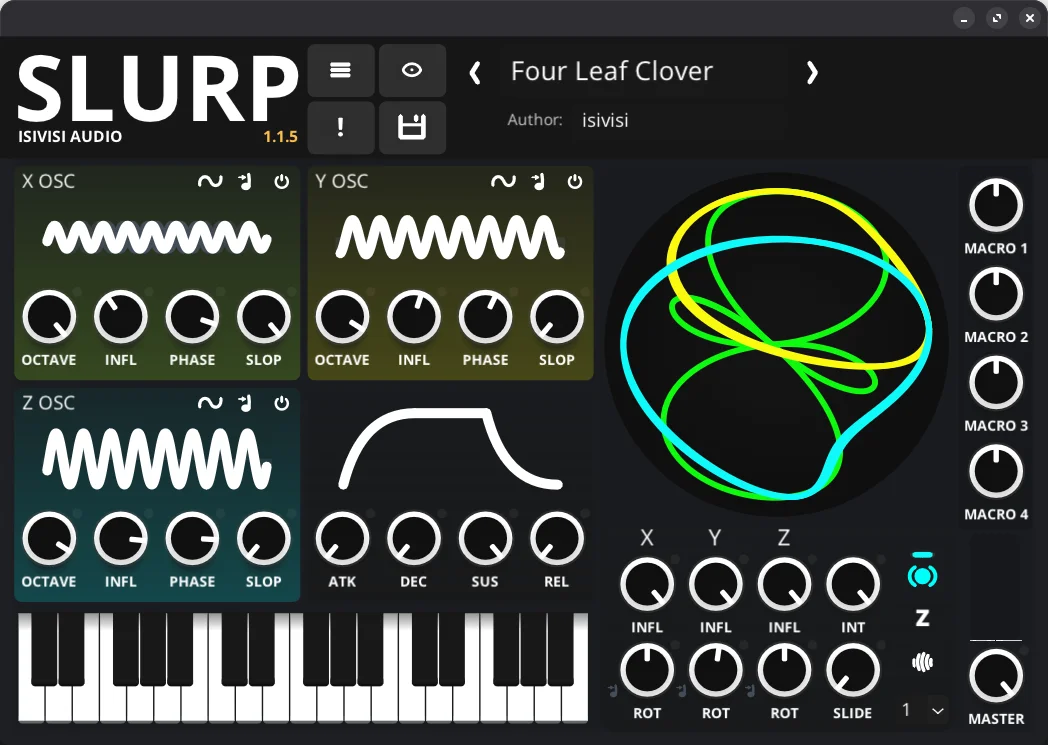
SLURP is a spatial FM synthesizer built around quaternion oscillation, where three oscillating sources rotate across X, Y, and Z axes before being projected back into audio. The result is a synth that feels less like programming static operators and more like shaping moving, three-dimensional tone paths.
The permanent no-cost Steal edition includes the standalone app plus VST3, CLAP, and AU builds for Windows, macOS, and Linux. It is intentionally limited to one voice and a smaller oscillator set, but it is not a timed demo and can still generate pads, leads, drones, and metallic FM textures with plenty of movement.
The central visualizer is useful because it shows the rotation path changing as you adjust oscillator choice, influence, intensity, phase, and projection angle. That makes the unusual concept easier to explore by ear, especially for producers who like experimental synthesis but do not want to start with a blank modular patch.
SLURP is strongest as a sound-design instrument for evolving timbres, animated mono leads, strange percussion layers, and texture beds. Users who need full polyphony, modulators, audio-input oscillation, and the expanded oscillator set can move to the paid edition, but the Steal edition is strong enough to justify its own SSA page.
Video Preview

Frequently Asked Questions
What is quaternion oscillation in SLURP?
SLURP uses three oscillating sources to create rotation across three axes, then projects that movement back into audio. You do not need to understand the math to use it, because the interface and visualizer make the motion easy to audition.
Is the Steal edition a timed demo?
No. Isivisi's Steal page states that the edition can be used indefinitely, but it is limited compared with the paid version.
What are the main limits of the Steal edition?
The no-cost edition is limited to one voice and a smaller oscillator set. The paid version adds 16 voices, all oscillators, modulators, and future major 1.x updates.
What kinds of sounds does SLURP suit best?
It is best for motion-heavy pads, evolving leads, drones, strange FM tones, and experimental texture work. The rotating oscillator model makes it especially useful when static subtractive or classic FM patches feel too predictable.


