
Spread Delay
Key Features
- Ping-pong style multi-tap delay that spreads repeats from the center toward the left and right channels
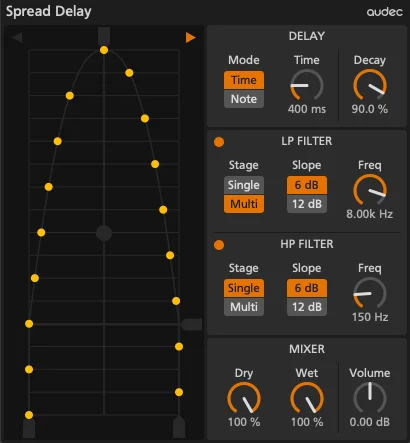
- Visual scope shows the dry signal and 16 delayed taps as yellow pan-position points
- Time and Note modes let the delay follow millisecond values or tempo-based note lengths
- Separate left and right width sliders define how wide the delayed signal can open
- Curve control shapes how gradually the delayed taps move across the stereo field
- Low-pass and high-pass filter section keeps repeats dark, bright, or tucked behind the source
- Dry, wet, and output controls make it easy to balance the effect inside a mix
Description
Spread Delay is a stereo multi-tap delay from Audec built around a clear left-right spread display. It sends up to 16 delayed taps outward from the dry signal, making ping-pong echoes feel more like a staged movement than a simple alternating bounce.
The main strength is how quickly it turns ordinary delay repeats into width, motion, and rhythmic space. Producers can set delay time by milliseconds or note values, then shape decay, dry/wet balance, output level, and the point where the taps reach maximum stereo width.
Its interface is unusually visual for a compact delay effect. Yellow scope points show the pan location of the dry sound and each repeat, while the sliders and center curve control define how the echo pattern opens across the stereo field.
Use it when a synth stab, vocal ad-lib, guitar phrase, or percussion hit needs movement without a heavy modulation rack. The built-in low-pass and high-pass filters help tuck the repeats behind the source, so it works best as a creative stereo delay rather than a transparent utility echo.
Video Preview


Frequently Asked Questions
What makes Spread Delay different from a normal ping-pong delay?
Instead of only alternating repeats between left and right, Spread Delay visualizes and shapes how a chain of taps moves outward from the center. That makes it useful for gradual widening effects and more controlled stereo motion.
Can Spread Delay sync to a project tempo?
Yes. The Delay section has a Mode chooser with Time and Note modes, so repeats can be set in milliseconds or by note length.
Does Spread Delay include tone shaping for the repeats?
Yes. The filter section provides low-pass and high-pass filters for the delayed signal, with selectable stage and slope options plus individual cutoff controls.
Is this mainly a mixing utility or a creative effect?
It can handle straightforward stereo delay duties, but its strongest use is creative movement. The scope and spread controls are designed for shaping how the echoes travel across the stereo image.


