
Superhet
Key Features
- Heterodyning-based synthesis creates new sum and difference frequencies from played MIDI notes, giving the instrument a pitch behavior that is deliberately less predictable than standard oscillator tuning
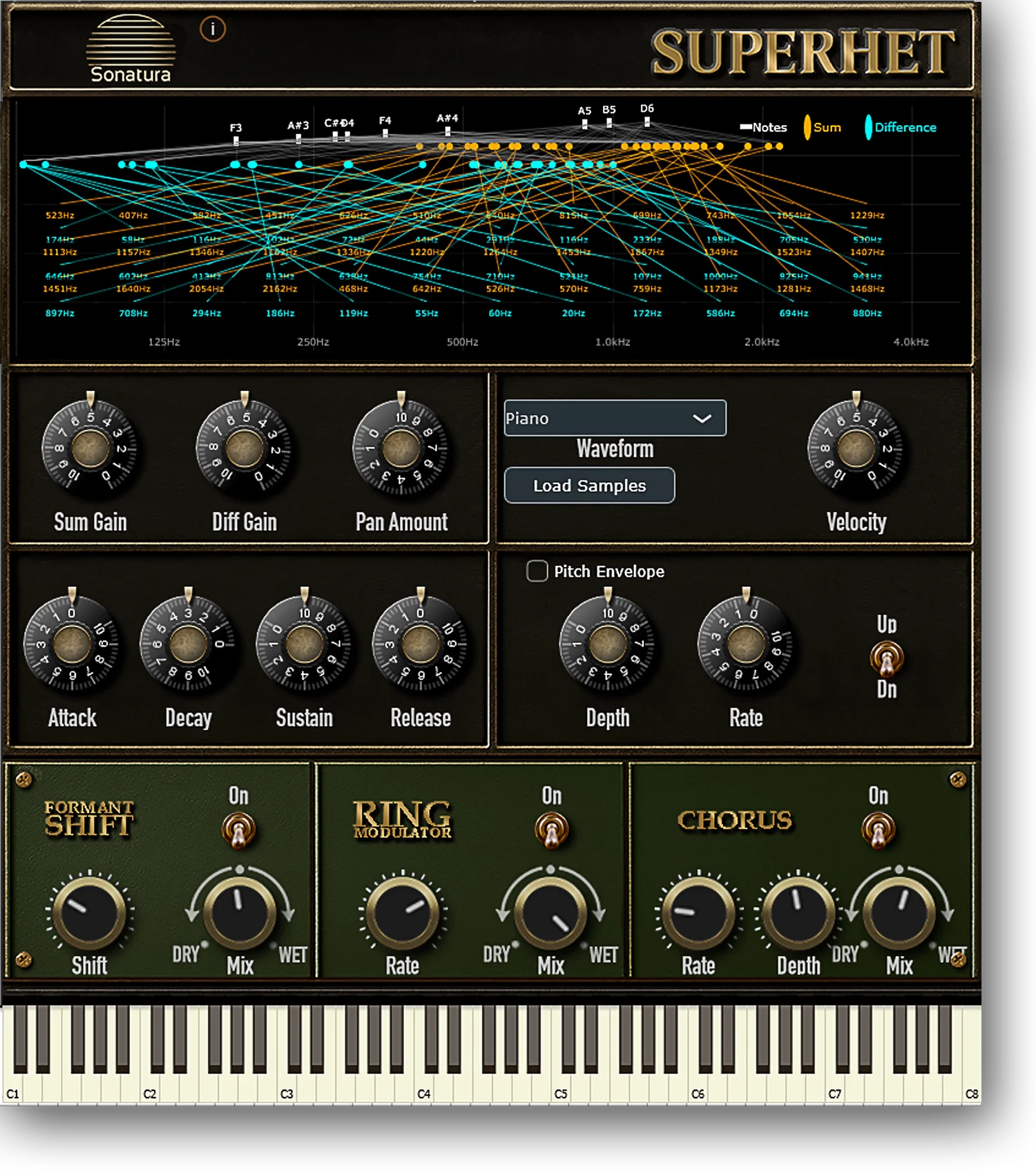
- Real-time frequency visualization separates input notes from generated tones, making it easier to understand which note pairs are creating the unusual harmonic results
- Independent sum and difference level controls plus panning let you balance the two generated frequency families or split them across the stereo field for wider experimental textures
- Built-in ADSR and switchable pitch-envelope controls provide enough shaping for drones, plucks, clusters, and evolving gestures without turning the plugin into a conventional synth workstation
- Factory waveform options include Piano, Gamelan, Vocal, String, Sine, Square, Triangle, and Sawtooth sources for different harmonic flavors
- Custom sample-set loading through manifest JSON files lets advanced users replace the built-in source palette with their own WAV-based material
Description
Superhet is an experimental software synthesizer that turns two or more MIDI notes into new sum and difference tones using heterodyning. Instead of preserving the notes you play, it replaces them with related frequencies that can feel stretched, unstable, microtonal, or harmonically unfamiliar.
The workflow is built around discovery rather than conventional subtractive programming. A real-time visualizer shows the input notes and generated frequencies, while separate sum and difference level controls, panning, ADSR shaping, and a pitch envelope let you steer the resulting clusters into drones, melodic fragments, or sharp synthetic gestures.
Superhet also goes beyond a fixed oscillator palette. The official manual lists Piano, Gamelan, Vocal, String, Sine, Square, Triangle, and Sawtooth sample options, and the product page links to JSON sample-loading resources so users can build their own waveform sets.
This is a strong catalog fit for producers who want new pitch relationships rather than another familiar analog-style synth. It is especially useful for experimental electronic writing, contemporary classical sketches, atmospheric scoring, and sound design sessions where unusual interval behavior is the point.
Frequently Asked Questions
What makes Superhet different from a normal software synth?
Superhet does not simply play back the notes you press. It uses heterodyning to generate sum and difference frequencies from note pairs, so the audible output can move into stretched, inharmonic, or microtonal-feeling territory very quickly.
Does Superhet need more than one MIDI note to work properly?
Yes. The manual explains that the heterodyning process requires at least two pressed notes, because the plugin needs two input frequencies before it can create sum and difference tones.
Can users load their own source sounds?
Yes. Sonatura documents a sample-set system built around a manifest JSON file and WAV files, with recommended sample rates such as 44.1 kHz, 48 kHz, and 96 kHz, 16-bit or 24-bit depth, mono files, and source samples up to 20 seconds.
What kinds of music does Superhet suit best?
It is strongest when the goal is unusual pitch behavior rather than familiar analog-style basses and leads. Ambient scoring, experimental electronic music, contemporary classical sketches, and sound-design beds are the most natural fits.


