
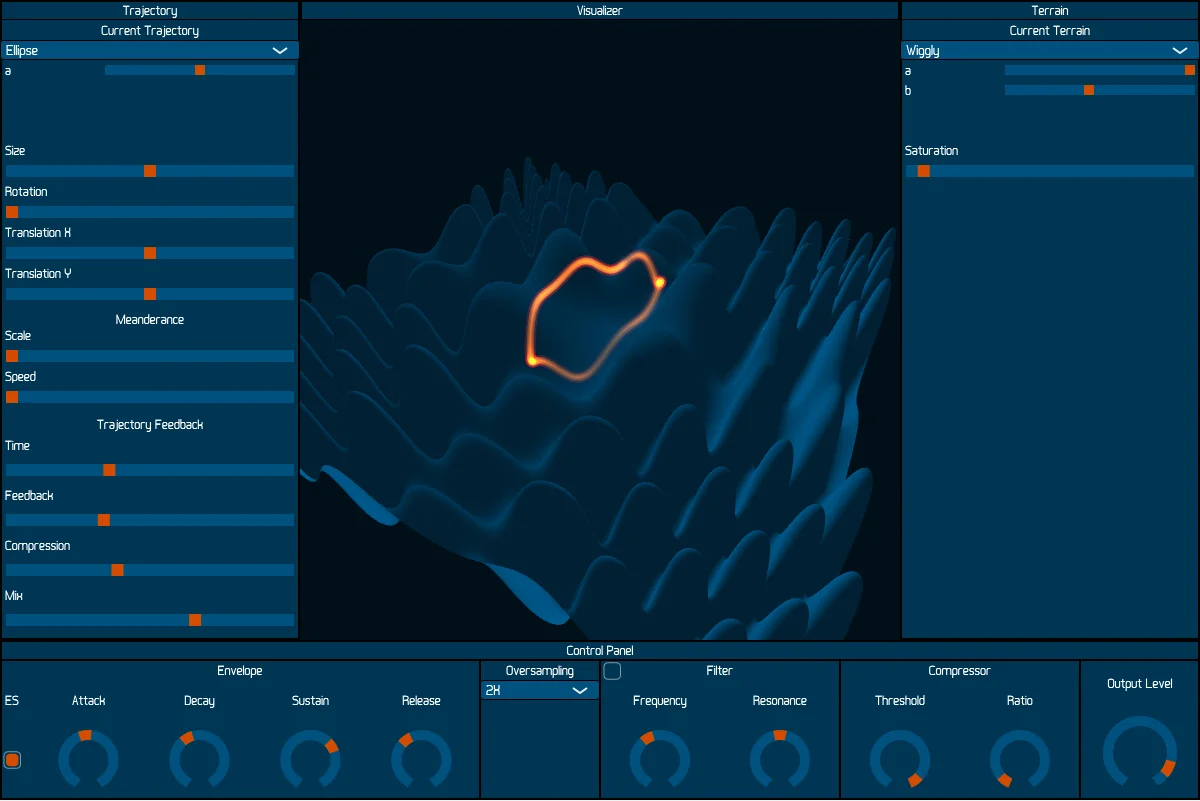
Terrain
Key Features
- Wave terrain synthesis engine scans a trajectory across a 3D surface for unusual, shape-driven oscillator tones.
- Audio-rate terrain and trajectory modulation supports animated timbres that go beyond static wavetable movement.
- Meanderance controls let the scan position drift around the terrain for evolving movement and shifting harmonics.
- Recursive trajectory feedback reshapes the scan path, with spatial compression to keep the two-dimensional feedback bounded.
- Terrain saturation and an analog-style envelope give extra tone shaping before the signal leaves the instrument.
- Oversampling helps reduce aliasing when using bright terrain shapes, feedback, or more aggressive modulation.
- Version 1.2.2 includes public installers for Windows, macOS, and Linux, with VST3, CLAP, and macOS package delivery.
Description
Terrain is an open-source wave terrain synthesis instrument from Aaron Anderson for macOS, Windows, and Linux. Instead of using a conventional oscillator, it scans a two-dimensional trajectory across a three-dimensional terrain so the tone depends on both the surface shape and the moving scan path.
The synth is built for experimental sound design rather than quick subtractive presets. Terrain and trajectory parameters can be modified at audio rate, giving it a hands-on way to move from stable tones into animated, mathematical timbres, evolving basses, metallic leads, and abstract textures.
The most distinctive controls are Meanderance and recursive trajectory feedback. Meanderance lets the scan move around the terrain over time, while the feedback loop reshapes the trajectory itself and uses a spatial compressor to keep the two-dimensional feedback under control.
Terrain also includes terrain saturation, an analog-style envelope, oversampling for alias reduction, preset management, CLAP support, and MTS-ESP microtonality support in later releases. The tradeoff is CPU load: the developer notes that both terrain and trajectory are calculated per sample, so high oversampling settings are better reserved for rendering or lighter patches.
Video Preview


Frequently Asked Questions
What is wave terrain synthesis in Terrain?
Terrain generates sound by moving a two-dimensional trajectory over a three-dimensional surface. The resulting timbre changes with the terrain shape, trajectory shape, scan position, and movement behavior rather than only with a traditional oscillator waveform.
Why can Terrain use more CPU than a typical synth?
The developer states that Terrain calculates both the terrain and trajectory per sample. Oversampling can reduce aliasing, but high oversampling factors add even more computation, so demanding patches may be better for rendering than live performance.
What does Meanderance do?
Meanderance moves an otherwise static trajectory around the terrain on its own. That changes which peaks and valleys are scanned over time, creating animated timbral motion without needing to manually automate every scan-position parameter.
Does Terrain support microtonality?
Yes. The official YouTube description notes that version 1.2.1 added MTS-ESP microtonality support, and the current public release is version 1.2.2.


