
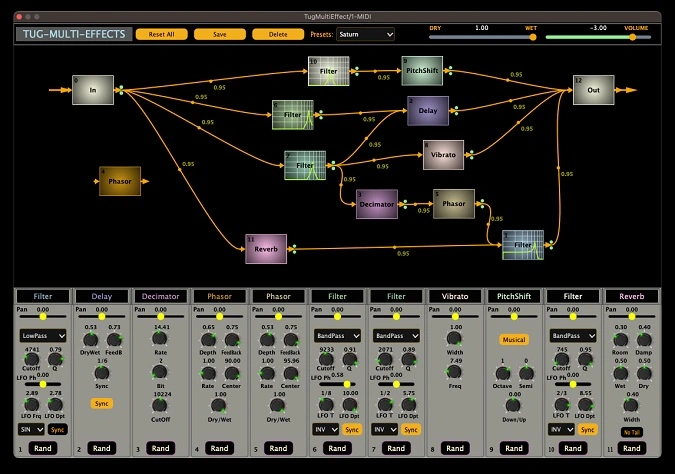
TugMultiEffect
Key Features
- 11 built-in effects (reverb, delay, chorus, decimator, distortion, phaser, pitch shifter, comb filter, vibrato, tremolo, and Moog-style filter) covering time-based, modulation, and tonal processing
- Fully modular drag-and-drop routing system that lets you connect effect modules in any serial, parallel, or hybrid signal path
- Moog-style ladder filter with self-resonance, multiple filter types, and a dedicated LFO with assignable modulation targets
- One-click randomizer for generating new parameter settings across all modules, accelerating sound design and happy accidents
- Modular-synthesizer-inspired interface with clearly labeled effect boxes and visible patch cables for intuitive signal flow
- Native Apple Silicon support on macOS alongside Intel compatibility and Windows support
Description
TugMultiEffect by 2RULE is a modular multi-effects plugin that bundles 11 audio processors into a single patchable interface. Instead of stacking effects in a fixed chain, you drag cables between module boxes to build custom signal paths — running processors in series, parallel, or any combination you can imagine.
The 11 included effects cover essential processing categories: reverb, delay, chorus, decimator, distortion, phaser, pitch shifter, comb filter, vibrato, tremolo, and a Moog-style ladder filter with self-resonance. Each module exposes dedicated controls for fine-tuning, and the filter module includes multiple types, pan, cutoff, resonance, and a built-in LFO with assignable modulation destinations.
The routing approach draws comparisons to modular environments like VCV Rack or Reaktor. You can wire a single input through massive parallel chains or collapse everything into one dense serial path.
A built-in randomizer generates new parameter settings across all modules instantly, making it a fast way to discover unexpected textures and combinations. The interface follows a modular-synthesizer aesthetic with clearly labeled boxes and patch connections.
It shares a visual lineage with 2RULE's other plugins, prioritizing experimentation and creative routing over conventional channel-strip workflows. Pairing it with the developer's companion glitch plugin TugGlicento opens up even more unconventional processing possibilities.
TugMultiEffect runs as a VST3 and AU plugin on macOS (Intel and Apple Silicon) and Windows. It is a 64-bit plugin with no additional dependencies required.
Video Preview

Tips
- Experiment with different routing configurations to create unique soundscapes.
- Use the randomizer to quickly generate new parameter settings and discover unexpected effects.
- Combine multiple effects in parallel chains for complex audio processing.
- Take advantage of the modular interface to customize your signal path.
- Use the Moog-style filter for adding warmth and resonance to your tracks.
- Save your favorite configurations as presets for quick recall in future projects.
Frequently Asked Questions
How does TugMultiEffect's routing system work?
TugMultiEffect uses a modular drag-and-drop patching system similar to VCV Rack or Reaktor. Each of the 11 effects appears as a box on the interface, and you draw cables between them to create custom signal paths. You can run effects in series, parallel, or any combination.
Can I use TugMultiEffect with TugGlicento?
Yes, pairing TugMultiEffect with 2RULE's TugGlicento glitch plugin is a popular combination for more extreme audio processing. You can run them in series within your DAW to combine modular multi-effects with glitch and stutter effects.
Does TugMultiEffect include any modulation options?
The Moog-style ladder filter module includes a built-in LFO with assignable modulation destinations. The plugin also has a randomizer that generates new parameter settings across all modules at once, which serves as a quick way to explore new textures.
What types of effects are included in TugMultiEffect?
TugMultiEffect includes 11 effects: reverb, delay, chorus, decimator, distortion, phaser, pitch shifter, comb filter, vibrato, tremolo, and a Moog-style self-resonance filter. These cover time-based processing, modulation, pitch manipulation, and tonal shaping.


