
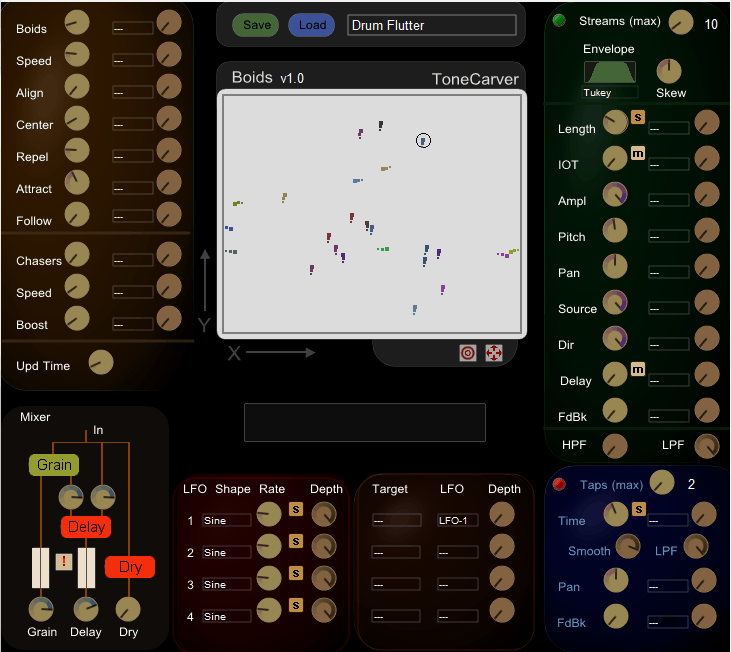
Boids
Key Features
- Hybrid granular and delay engine driven by a real-time 2D boid flocking simulation
- Up to 200 simultaneous grain streams, each linked to an individual boid agent
- Up to 200 delay taps with per-tap modulation from boid X/Y position, radius, and ID
- Visual swarm display lets you watch and adjust flock behavior as it modulates audio
- Adjustable flocking rules including speed, proximity, centering, leader-following, and direction matching
- Modulation assignments map boid coordinates to pan, pitch, feedback, and other grain or delay parameters
- Ships with a detailed manual covering all controls and modulation routing options
Description
Boids by ToneCarver is a hybrid granular and delay effect that uses flocking algorithms to modulate audio parameters in real time. Based on Craig Reynolds' boid simulation, the plugin treats a 2D swarm of up to 200 virtual agents as a modulation source, mapping each agent's X and Y position to grain and delay controls.
Originally built for the KVR Developer Challenge 2012, the plugin was designed around two goals: managing grain swarms visually and producing delay-based ambiance with organic, non-random variations. Each grain stream and delay tap links to a specific boid, so parameters like stereo pan, pitch, and feedback shift continuously as the flock moves through the coordinate space.
The granular engine supports up to 200 simultaneous grain streams, while the delay section provides an equal number of taps. Boid properties including X position, Y position, radius, and ID number can all serve as modulation assignments, giving each voice its own evolving behavior within the swarm.
Users describe the results as powerful and versatile, though the interface rewards patience. The swarm-driven modulation creates textures that sit between structured repetition and true randomness, making it especially effective for evolving pads, atmospheric drones, and experimental sound design.
Boids runs as a 32-bit and 64-bit VST on Windows, with both versions included in a single download weighing roughly 12 MB.
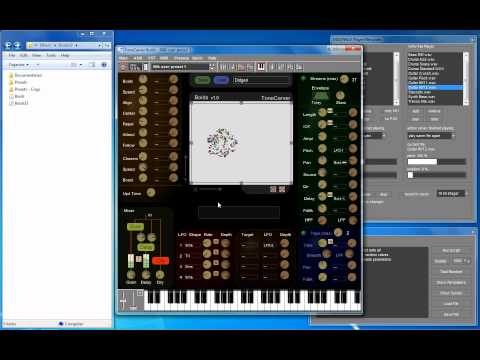
Video Preview
Frequently Asked Questions
How does the boid swarm actually affect the sound?
Each boid in the 2D swarm has an X position, Y position, radius, and ID number. You assign these properties to modulate grain and delay parameters like pan, pitch, or feedback. As the flock moves, every grain stream and delay tap updates in real time, creating organic stereo movement and timbral shifts that feel structured rather than purely random.
Is there latency between the dry and wet signal?
Some users have reported a noticeable delay of several hundred milliseconds between the dry input and the wet output. This is inherent to how the granular buffer and delay taps operate. For best results, use Boids as a send effect or on a parallel channel rather than as an insert with dry/wet blending.
Can Boids be used for ambient and drone music?
Yes, ambient and drone production is one of its strongest use cases. The swarm-modulated delays create slowly evolving textures that avoid the mechanical repetition of standard delay plugins. Feeding sustained pads or field recordings through Boids can generate hours of shifting, organic ambience.
How steep is the learning curve?
The interface is more complex than a typical delay plugin because of the flocking parameter controls and modulation routing. Users recommend reading the included manual and starting with a small number of boids to understand how each flocking rule affects the output before scaling up to larger swarms.


