
Domina
Key Features
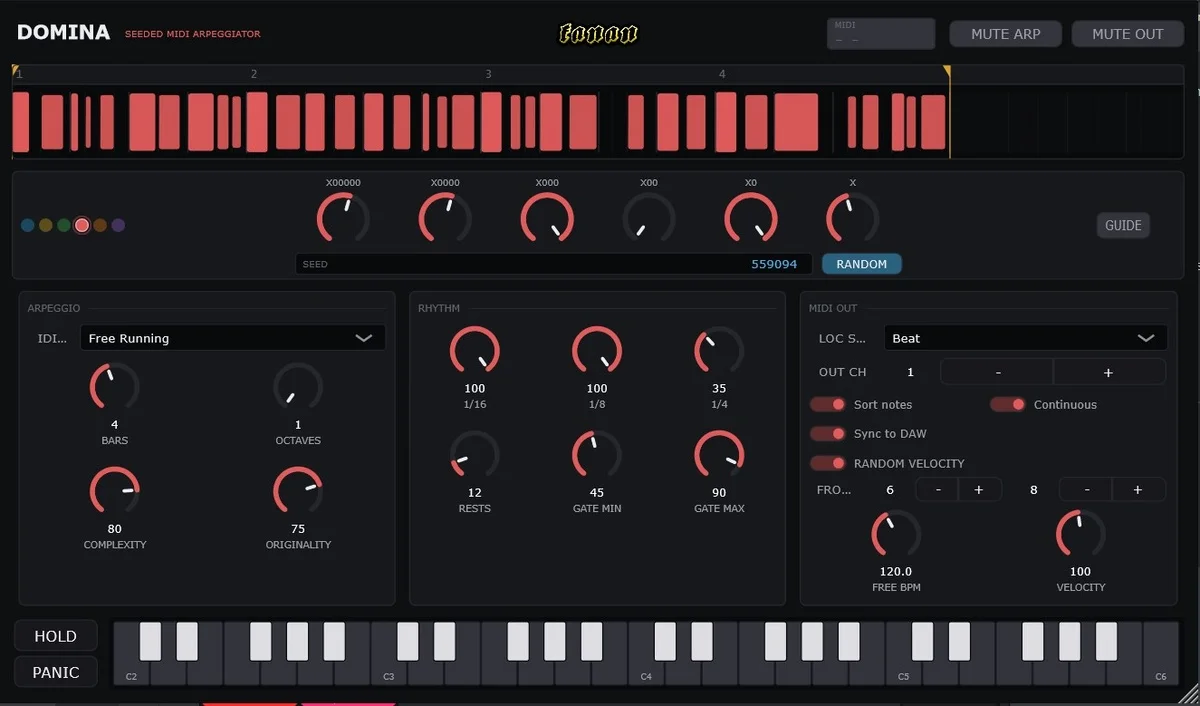
- Six-digit seed system rebuilds a full MIDI phrase, including rhythm, rests, ties, accents, and melodic contour
- Three independent seed streams keep musical form, rhythm, and pitch behavior separately adjustable
- Idiom bank covers Latin, Folk, Gospel, Metal, Disco, 80s Pop, Reggae, Trance, House, Dance, Rock, Oriental, and 3/4 styles
- Complexity, originality, octave range, note-length weighting, rests, and gate limits shape how dense or sparse each generated phrase becomes
- Chord-responsive output follows the notes held at the input, so the same seed can adapt to a progression
- RANDOM and HOLD support variation and bar-focused looping during playback
- MIDI learn supports mapping controls and the RANDOM button to a controller for performance use
Description
Domina is a MIDI-only arpeggiator from Fanan Team that turns a six-digit seed into a repeatable performance pattern for another instrument in your DAW. It creates note lengths, rests, ties, accents, and melodic movement from the seed, while the chord you play determines the notes it sends onward.
The seed is more like a compact recipe than a conventional preset: enter the same number again and Domina rebuilds the same phrase. Separate musical-form, rhythm, and pitch streams let you reshape one part of the result without automatically replacing the others.
Instead of cycling through a fixed up/down order, Domina works with idiom-based patterns and controls for complexity, originality, octave range, note-length balance, rests, and gate limits. That makes it practical for moving from sparse held figures to faster rolling textures without step-programming every variation.
It is also set up for hands-on use. RANDOM can generate a new seed during playback, HOLD freezes the current bar, and MIDI learn can map the controls to hardware so a phrase can evolve while a session or performance continues.
Frequently Asked Questions
Does Domina make sound by itself?
No. Domina is a MIDI arpeggiator, so it sends notes to an instrument placed after it in the DAW signal chain. Load or route it to a synth, sampler, or other MIDI-capable sound source to hear the result.
What does the six-digit seed do?
The seed is the identifier for a generated pattern. Re-entering the same number rebuilds its musical form, rhythm, and pitch behavior, so a phrase can be recalled or shared without saving a conventional patch.
Can the pattern follow different chords?
Yes. The generated line responds to the chord or notes at the input, so changing the harmony changes the notes sent to the target instrument while retaining the selected pattern behavior.
Which plugin formats and platforms are listed?
The current release coverage and KVR listing identify VST3, AU, and CLAP builds for Windows and macOS. No system-version, CPU, or RAM requirements were supplied in the verified release information.


