
Hammer & Meißel
Key Features
- Polyphonic modal filtering for turning audio into tuned resonant textures
- MIDI input and key-selector control for playing the filter response melodically
- Per-voice ADSR, modal, formant, comb, and lowpass stages for layered tone shaping
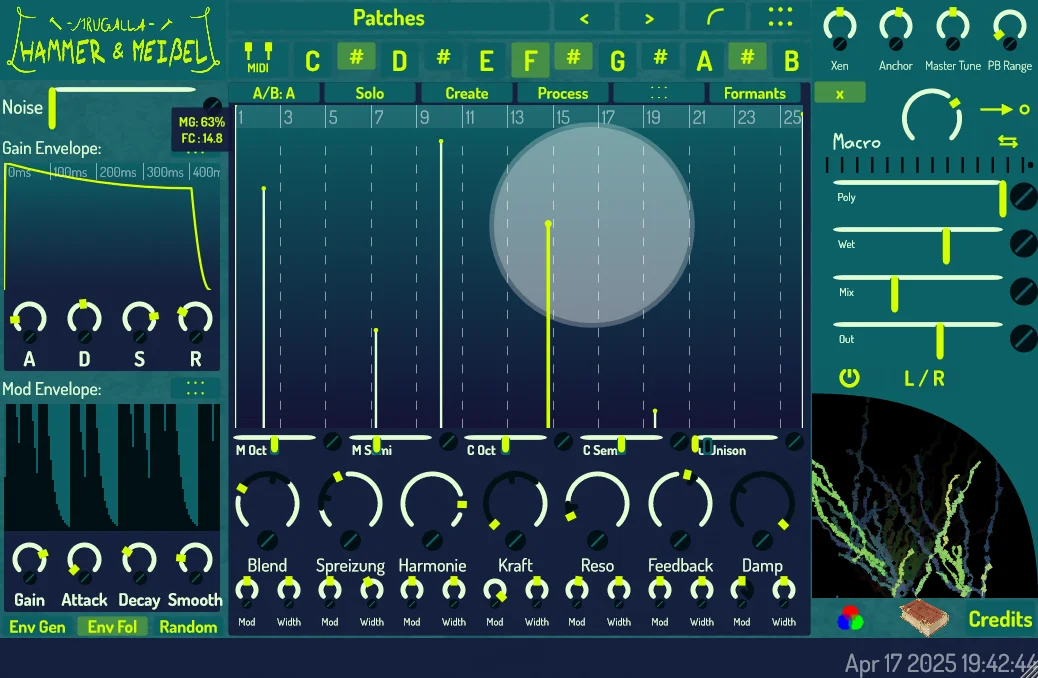
- Material editor with draggable partials, sample drag-and-drop, and generated starting points
- Mod envelope modes for tempo-synced envelopes, envelope following, and Perlin-noise randomization
- Blend, spread, harmony, saturation, resonance, feedback, unison, damp, and stereo modulation controls
Description
Hammer & Meißel is a polyphonic modal filter effect that turns incoming audio into pitched, resonant material. It can behave like a playable filter bank, a texture generator, or a strange noise-driven instrument when you feed it drums, field recordings, synths, or other dynamic sources.
Each voice combines an ADSR envelope, modal filter, formant filter, comb filter, and lowpass filter, with MIDI input and a key selector for controlling the resonant pitches. The modal material editor lets you drag partials directly, drop in a sample, or generate starting points from waveforms, prime numbers, Fibonacci ratios, and randomization.
The result is strongest as a sound-design processor rather than a conventional mix filter. Use it to turn non-tonal material into bells, pads, animated chords, metallic percussion, and evolving harmonic beds while keeping wet/dry, output, transpose, xen-scale, modulation, and stereo controls close at hand.
The GitHub release provides current VST3 builds for Windows, macOS, and Linux without account signup. The latest listed update fixes key-selector edge cases, reduces CPU load, improves sound quality, and adds a panic button for troubleshooting.
Video Preview


Frequently Asked Questions
Is Hammer & Meißel more like a filter or an instrument?
It sits between both. You insert it as an effect, but its keytracked modal filters, MIDI input, and noise generator let it create pitched, playable material from incoming audio.
What kinds of sources work best with it?
Dynamic and non-tonal sources are the most interesting starting points. Drum loops, field recordings, noise, and percussive hits can become bells, chords, pads, or animated textures.
Can it create custom resonator material?
Yes. The material editor supports manual partial dragging, sample drag-and-drop, and generated tables from waveforms, prime numbers, Fibonacci ratios, and random processes.
Does it support Linux?
Yes. The release includes Windows, macOS, and Linux assets, with the Linux build provided as a 64-bit shared-object plugin file.


