
Inner Pitch Free Edition
Key Features
- State-of-the-art pitch shifting engine with two-octave range that preserves the natural character of vocals, instruments, and full mixes
- Independent formant shifting with two-octave range for reshaping tonal character without affecting pitch
- Built-in delay unit with Ping-Pong, diffusion, and infinite feedback for creative sound design and endlessly ascending or descending textures
- 3-band spectral EQ for sculpting the tone of the pitch-shifted signal before output
- Stereoization via left/right pitch offset to create wide, immersive spatial effects from mono sources
- Three types of in-loop distortion including an ADPCM-like game codec emulation for experimental texturing
- Low 17.8 ms latency for practical near-real-time tracking and live performance use
Description
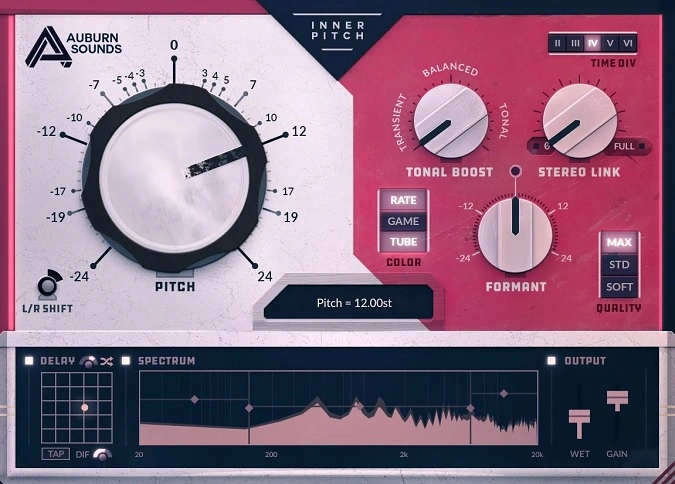
Inner Pitch Free Edition by Auburn Sounds is a pitch-shifting delay plugin built around one of the most natural-sounding pitch engines available today. It handles vocals, guitars, strings, and even full mixes with minimal artifacts, preserving stereo imaging and the original performance's character throughout.
The plugin offers pitch shifting and independent formant shifting, each with a two-octave range in either direction. A 3-band spectral EQ lets you sculpt the tone of the shifted signal, while a stereoization feature creates width by offsetting the pitch between left and right channels.
Beyond standard pitch correction and tuning tasks, Inner Pitch doubles as a creative sound design tool. Its built-in delay section includes Ping-Pong mode, diffusion, and infinite feedback for generating endlessly ascending or descending sonic textures.
Three types of in-loop distortion, including an ADPCM-like game codec emulation, push the plugin further into experimental territory. The interface keeps things straightforward with clearly labeled controls for pitch, formant, tonal boost, and color.
Latency sits at just 17.8 ms, lower than Auburn Sounds' own Graillon, making it practical for near-real-time tracking. The Free Edition includes all core pitch-shifting and delay features without time limits or added noise, though the Full Edition unlocks additional quality modes and vocal hard-tuning.
Video Preview


Tips
- Use pitch shifting to create unique vocal effects and harmonies.
- Experiment with formant shifting to alter the character of vocal recordings.
- Apply the delay unit to add depth and movement to your tracks.
- Utilize the 3-band EQ to fine-tune the tonal balance of your pitch-shifted sounds.
- Combine pitch shifting with stereoization to create wide, immersive soundscapes.
- Explore the in-loop distortion options to add texture and grit to your sounds.
- Use the plugin on instruments like guitars and strings to generate unusual textures.
- Employ the endless ascent or fall feature to create evolving soundscapes in your compositions.
Frequently Asked Questions
What is the difference between Inner Pitch Free Edition and Full Edition?
The Free Edition includes all core features: pitch shifting, formant shifting, the 3-band spectral EQ, delay unit, and distortion modes. The Full Edition unlocks additional quality fine-tuning options for higher audio fidelity, more CPU-efficient modes, and vocal hard-tuning capabilities. There is no time limit or added noise in the Free Edition.
How does Inner Pitch compare to Graillon for pitch shifting?
Both are made by Auburn Sounds, but they serve different purposes. Graillon focuses on pitch correction and autotune effects, while Inner Pitch is dedicated to pitch shifting with a delay section for creative sound design. Inner Pitch also has lower latency at 17.8 ms compared to Graillon's 23 ms.
Can Inner Pitch handle polyphonic material like full mixes?
Yes. Auburn Sounds specifically designed Inner Pitch to work on any source material, including single instruments, multiple voices, and full stereo mixes. The algorithm decorrelates internal parameters to avoid the typical trade-off between monophonic and polyphonic performance.
What are the in-loop distortion types used for?
Inner Pitch offers three distortion modes applied within the delay feedback loop: standard saturation, tube-style warmth, and an ADPCM-like game codec emulation. These add grit and texture to the delayed pitch-shifted signal, which is particularly useful for creating experimental soundscapes and lo-fi effects.


