LibreArp
Key Features
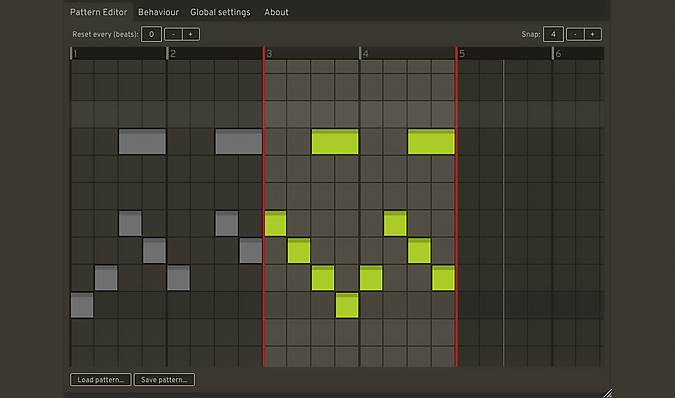
- Free-form pattern editor with piano-roll-style drawing for fully custom arpeggio shapes
- Infinite polyphony allows multiple simultaneous notes within a single pattern step
- Realtime swing control adds human-like timing variation to rigid patterns
- Smart Octaves ensures higher pattern note numbers always play at higher pitches
- Chord Size parameter locks the number of active notes for consistent behavior across different chord inputs
- Movable loop region with arbitrary start points and pattern playback offset for creative flexibility
- Save and load user presets to quickly recall favorite arpeggio patterns across projects
Description
LibreArp is an open-source pattern-based arpeggiator plugin that turns held chords into rhythmic melodic sequences using custom-drawn patterns. Built with the JUCE framework by developer Oto Stava, it runs as a MIDI effect in any VST3 or LV2 host on Windows, macOS, and Linux.
Unlike traditional arpeggiators that cycle through fixed up-down-random modes, LibreArp lets you draw your own pattern from scratch in a piano-roll-style editor. Each input note is assigned a number based on pitch, and the pattern determines which note number plays at each step.
The pattern editor supports infinite polyphony, so multiple notes can trigger simultaneously within a single pattern. A freely movable loop region lets you set arbitrary start points, and notes placed outside the loop are automatically disabled.
Version 2.5 adds selection duplication, pattern playback offset, and manual time signature support. Realtime swing brings a human feel to rigid patterns, while Smart Octaves ensures higher pattern notes always produce higher pitches.
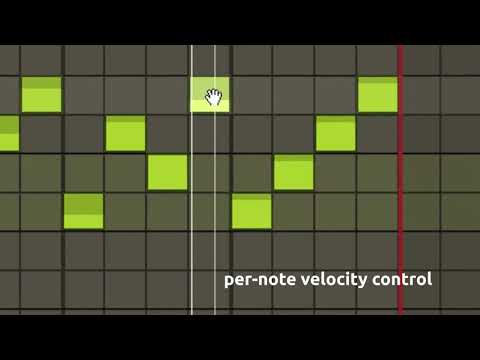
Chord Size locks the number of active notes for consistent results across different chord voicings. The Behaviour tab provides MIDI channel routing and an option to use input note velocity, letting you preserve the dynamics of your original performance.
All patterns can be saved and loaded as user presets for quick recall across projects. The plugin weighs in at roughly 1.5 MB, making it one of the lightest arpeggiators available.
Video Preview

Frequently Asked Questions
How does LibreArp differ from a standard DAW arpeggiator?
LibreArp uses a free-form pattern editor where you draw your own arpeggio shapes, rather than selecting from fixed modes like up, down, or random. This gives you full creative control over which notes play when, including polyphonic patterns where multiple notes sound simultaneously.
Does LibreArp work as a standalone application?
No, LibreArp is a MIDI effect plugin that requires a DAW host. It is available in VST3 and LV2 formats and must be placed before a virtual instrument in your signal chain to generate arpeggiated MIDI output.
Can LibreArp handle chord changes during playback?
Yes. LibreArp assigns each input note a number based on pitch, so when you change chords, the pattern automatically remaps to the new notes. If a pattern references a note number higher than the input chord contains, it wraps around and transposes up by an octave.
Is LibreArp compatible with Apple Silicon Macs?
Yes. The KVR listing confirms LibreArp includes a Universal 2 Binary, meaning it runs natively on both Intel and Apple Silicon Macs without Rosetta.