
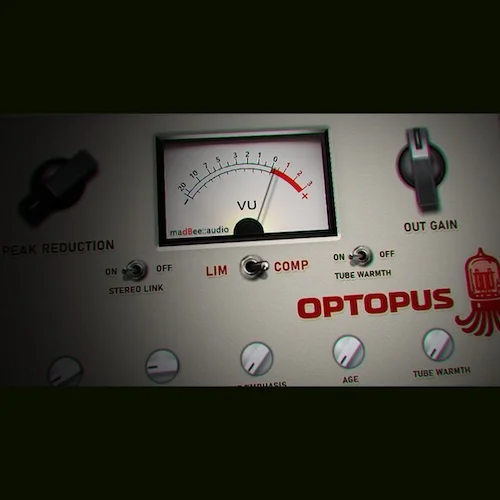
Optopus
Key Features
- Models program-dependent electro-optical compression for smoother, musical level control.
- Switches between Compress for gentler leveling and Limit for firmer peak management.
- Offers feedback and feedforward detector behaviors for two distinct response styles.
- Uses a frequency-shaped sidechain with adjustable high-frequency emphasis.
- Adds optional tube-style saturation with a variable Warmth control and 4x oversampling.
- Provides an Age control that moves the circuit character from newer to more vintage-like drift.
Description
Optopus is a Windows-only opto-style compressor from madBee::audio that pairs program-dependent leveling with an optional tube-style saturation stage. It is an original optical design rather than a recreation of a specific hardware unit, so its Compress and Limit modes cover gentle leveling as well as firmer peak control.
Feedback and feedforward detector choices let you move between two compression behaviors, while a frequency-shaped sidechain can put more weight on higher-frequency information. That makes it practical to keep heavy low end from dominating the detector or to make the action more responsive to brighter detail.
Switch on the tube stage when the source needs harmonic density as well as gain reduction, then set Warmth to control the amount of color. The 4x oversampling option supports that non-linear stage, and Age shifts the modeled circuit from a newer response toward more component-drift character.
Optopus suits vocals, bass, guitars, acoustic instruments, and other tracks that benefit from smoother dynamic control before aggressive transient shaping becomes necessary. Its 64-bit VST3 format is specifically for Windows DAWs, and the public developer Patreon post hosts the ZIP attachment without a paid membership or email form.
Video Preview

Frequently Asked Questions
Is Optopus an LA-2A emulation?
No. madBee::audio presents Optopus as an original opto-style design, not as a model of a particular classic leveling amplifier. It uses the smooth, program-dependent behavior associated with optical compression while adding its own detector, Age, and saturation controls.
What is the difference between Compress and Limit modes?
Compress is the gentler option for broad leveling, while Limit moves toward stronger peak control. The developer also includes feedback and feedforward behavior choices, so the detector response can be adapted beyond a typical two-knob optical compressor.
Can Optopus add saturation as well as compression?
Yes. Its optional tube-style saturation stage has a Warmth control for the amount of harmonic color, and the developer lists a 4x oversampling option for that stage. Age additionally changes the modeled circuit character from a newer state toward more component drift.
Which systems and plugin formats does Optopus support?
The developer and the discovery article identify Optopus as a 64-bit VST3 plugin for Windows. No macOS or Linux build is listed, so it requires a Windows DAW that can host 64-bit VST3 effects.


