
Key Features
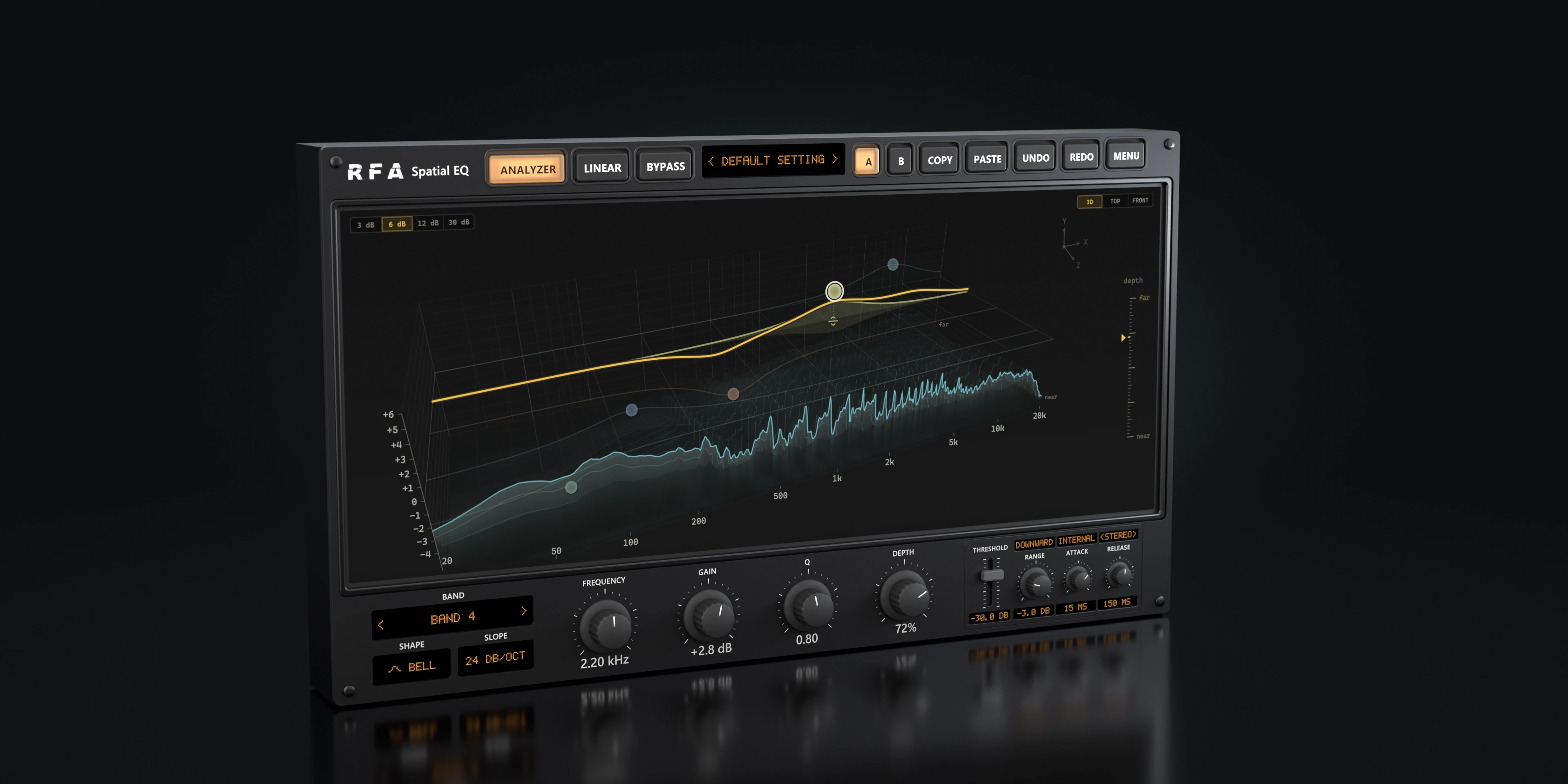
- Shape eight frequency bands with independent depth controls
- Spread boosted frequency regions with short reflections or target cuts toward the sides
- Switch between front, top and rotatable 3D spectrum views
- Apply upward or downward dynamics and external sidechain input to each band
- Choose stereo, left, right, mid or side processing per band
- Select zero-latency or linear-phase operation
- Start with 100 presets and compare settings with A/B controls
Description
Spatial EQ is an eight-band equalizer from RiverFlux Audio that adds a depth control to each frequency band. It combines tonal shaping with stereo placement and short reflections, letting you give selected parts of a sound more apparent space.
Boost a band and increase its depth to spread that frequency region toward the sides and add reflections behind it. For cuts, depth shifts the reduction away from the center and toward the sides, which can help clear wide material while preserving its central component.
The interface offers front, top and rotatable 3D views of the spectrum. Each band supports upward or downward dynamics with an external sidechain, and can address stereo, left, right, mid or side signals independently.
Seven filter shapes cover bells, shelves, cuts, notch and band-pass filtering. Zero Latency and Linear Phase modes offer different processing choices, while band auditioning, A/B comparison and undo make it easier to evaluate adjustments.
Try placing the upper frequencies of a vocal farther back while keeping its body forward, or widening a pad without adding the same space to its low mids. The plugin includes 100 presets and lets users save and share their own settings.
Spatial EQ is available through the developer's name-your-price storefront with a zero minimum and optional donations. Windows and Linux builds use VST3; macOS adds AU and supports Apple Silicon and Intel.
Frequently Asked Questions
What does the Depth control change?
On boosts, Depth adds stereo spread and short reflections to the selected frequency region. On cuts, it shifts the reduction toward the sides.
Can Spatial EQ work as a conventional equalizer?
Yes. At zero Depth, the band adds no spatial effect, so you can use its frequency, gain and Q controls for ordinary EQ adjustments.
Can the EQ respond to another track?
Each band offers dynamic processing with an external sidechain. This allows another signal to drive that band’s response.
Can it widen a mono track?
The developer says a mono track needs a stereo output to become wider. Set up the track accordingly before judging the spatial effect.


