
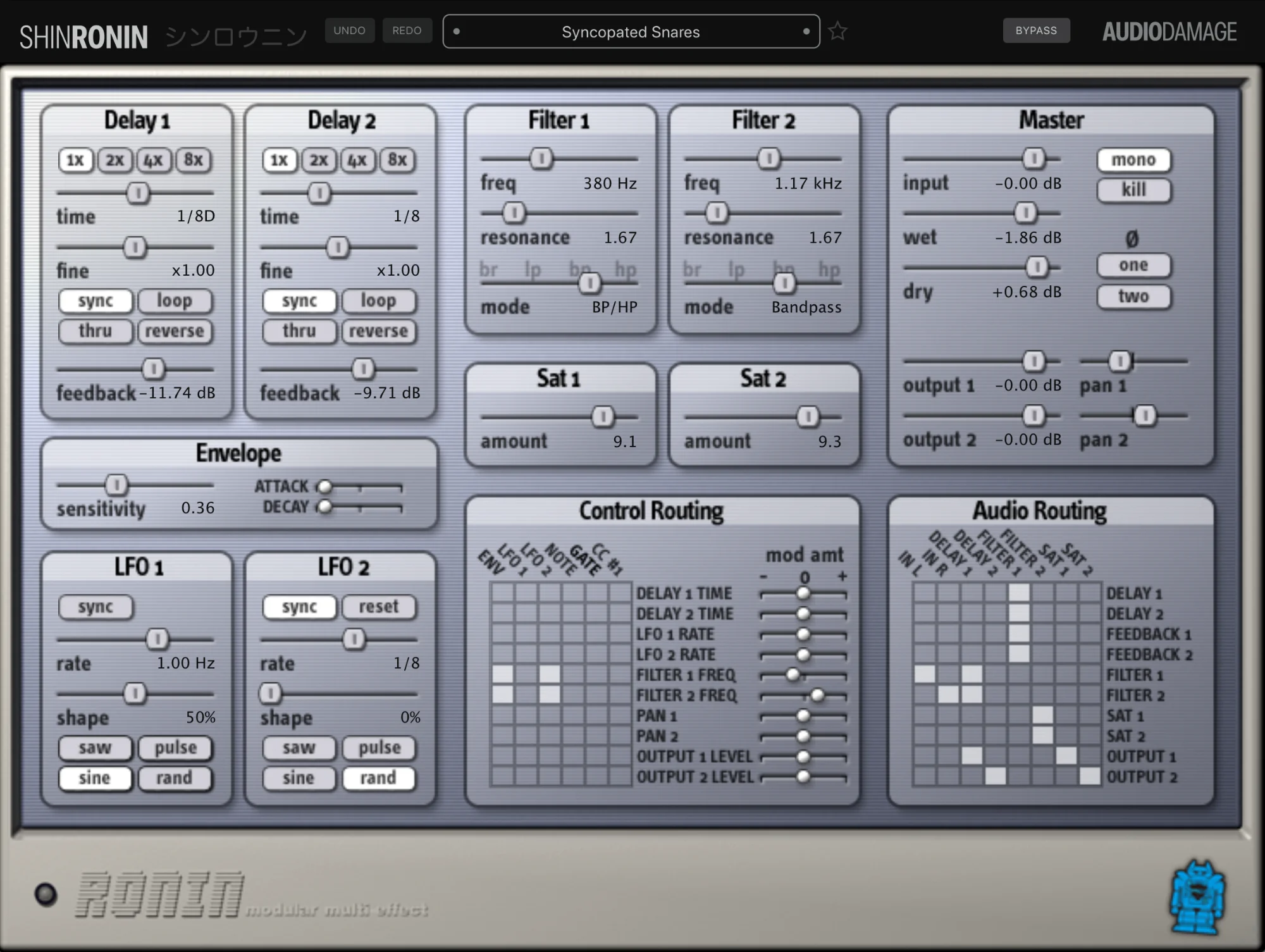
ShinRonin
Key Features
- Two independent delay lines with tempo sync, reverse, looping, and feedback for everything from stereo echoes to unstable repeat networks
- Dual morphing multimode filters that sweep continuously through notch, lowpass, bandpass, and highpass responses
- Signal routing matrix for cross-feeding delays, changing filter order, and creating feedback paths inside the plugin
- Modulation matrix that connects two LFOs, an envelope follower, and incoming MIDI to nearly any parameter
- Built-in saturation stages for adding grit, harmonics, and extra intensity before or after delay/filter processing
- Modern desktop builds for macOS, Windows, and Linux with CLAP, VST3, AU, AAX, and LV2 coverage across supported platforms
Description
ShinRonin is Audio Damage's modern rebuild of Ronin, a modular filter and delay effect built around two delay lines, two morphing filters, saturation, modulation, and patchable routing matrices. It can behave like a clean stereo delay, but its real personality comes from rewiring the internal signal path into feedback networks and animated filter movement.
Each delay line includes tempo sync, reverse, looping, and feedback, while the filters morph continuously between notch, lowpass, bandpass, and highpass responses. Two LFOs, an envelope follower, and MIDI modulation feed a control matrix that lets movement reach nearly any parameter.
The audio matrix is the feature that separates ShinRonin from a normal delay/filter chain. You can cross-feed delays, reorder filters, send modules back into themselves, and build unstable textures that range from dub-style repeats to self-oscillating sound design.
The rebuild keeps the cult architecture of the 2003 original while updating it for current desktop systems and plugin formats. It is best treated as a creative effect for producers who like hands-on experimentation, evolving transitions, distorted echoes, and unusual rhythmic motion.
Frequently Asked Questions
How is ShinRonin different from a normal delay plugin?
ShinRonin is built around two routing matrices instead of a fixed signal path. The audio matrix lets you route modules into each other, including feedback paths, while the modulation matrix connects LFOs, envelope following, and MIDI control to a wide range of parameters.
What kinds of sounds does ShinRonin suit best?
It works for clean stereo delays and filtering, but it is strongest when used for evolving, unstable, or rhythmic effects. The delay feedback, morphing filters, saturation, and patchable routing make it especially useful for transitions, texture beds, dub-style repeats, and experimental sound design.
Is ShinRonin a direct port of the old Ronin plugin?
No. Audio Damage describes ShinRonin as a ground-up rebuild that carries forward the original Ronin architecture rather than a simple port. The result preserves the dual-delay, dual-filter, matrix-based concept while targeting modern operating systems and plugin formats.
Does ShinRonin require an Audio Damage account or copy protection?
No. Audio Damage says the desktop downloads have no demo timer, DRM, iLok, online activation, account requirement, or expiration. The product page provides direct downloads for Windows, macOS, and Linux.


