The Overheads
Key Features
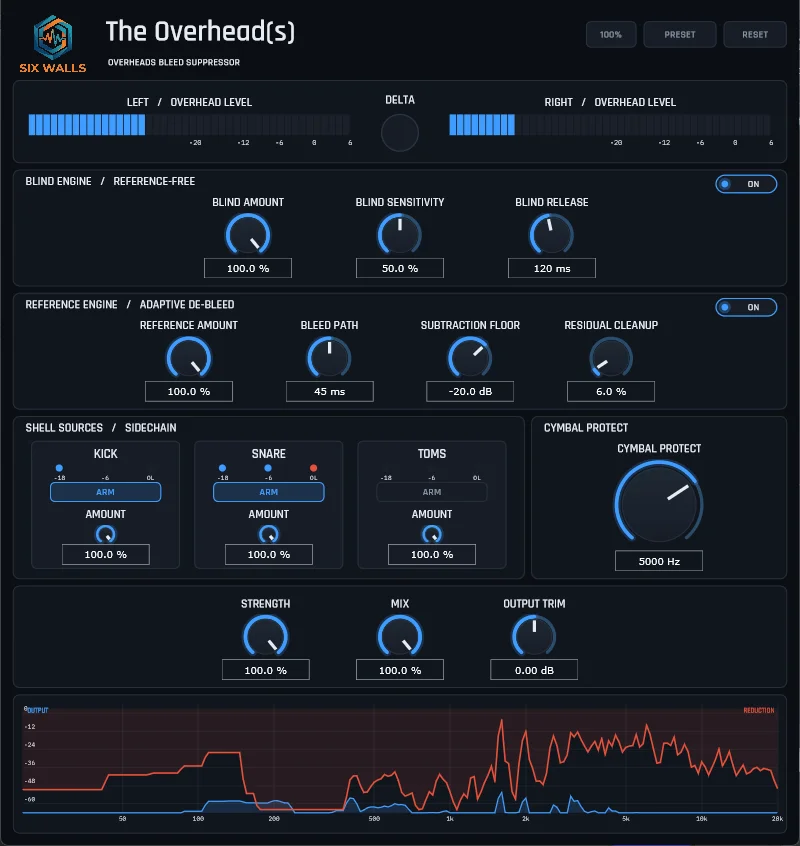
- Targets kick, snare, and tom bleed inside the overhead recording instead of removing cymbals from close microphones.
- Reference-free Blind engine ducks shell-hit energy using linear-phase spectral processing.
- Reference engine learns spill paths from routed kick, snare, and tom close-mic sidechains.
- Cymbal Protect tapers the processing above an adjustable crossover to help preserve brightness.
- Run either engine independently or combine both in series.
- Delta monitoring reveals the removed material, with strength, dry/wet mix, and output controls.
- Reports processing latency to the host for plugin delay compensation.
Description
The Overheads, branded The Overhead(s) by Six Walls, reduces kick, snare, and tom spill in drum overhead microphones. It is designed to give the close-miked shells more independence in a mix while retaining the overheads' cymbal contribution, addressing the opposite problem to removing cymbals from a snare track.
The Blind engine works without reference tracks. Its linear-phase spectral processing ducks the energy of shell hits and tapers the reduction above a tunable Cymbal Protect crossover, instead of applying a permanent EQ cut to the recording.
The Reference engine uses the close microphones as sidechain sources. A per-source adaptive filter learns the spill path for kick, snare, or toms and subtracts that contribution from the overhead signal, making the recording's routing part of the cleanup process.
Either engine can run alone, or both can operate in series. Delta monitoring lets you hear the removed signal, while strength, mix, and output controls help balance the processing against the original overheads.
This is a mixing tool with reported latency for host delay compensation, rather than a zero-latency tracking processor. The manual also makes clear that it reduces bleed rather than perfectly isolating cymbals, so overlapping shell and cymbal energy still calls for careful adjustment and listening.
Frequently Asked Questions
Does The Overheads remove cymbals from a snare track?
It targets the opposite direction: kick, snare, and tom spill in the overhead microphones. Its purpose is to reduce shell energy in the overheads while preserving useful cymbal content.
Do I need close-mic reference tracks?
The Blind engine does not require references. The Reference engine needs routed kick, snare, or tom close-mic signals to learn and subtract their spill paths.
Can I hear what the processing removes?
Yes. Delta monitoring lets you listen to the removed material, which helps you judge whether useful cymbal detail is being affected. The two engines can be auditioned separately or used in series.
Will it perfectly isolate the cymbals?
No. The manual describes bleed reduction rather than perfect isolation, and shell hits can share energy with cymbals. Adjust the protection, strength, and mix controls while checking the full drum mix.