
STONE
Key Features
- Acqua channel-strip workflow built around broad tone shaping rather than surgical correction.
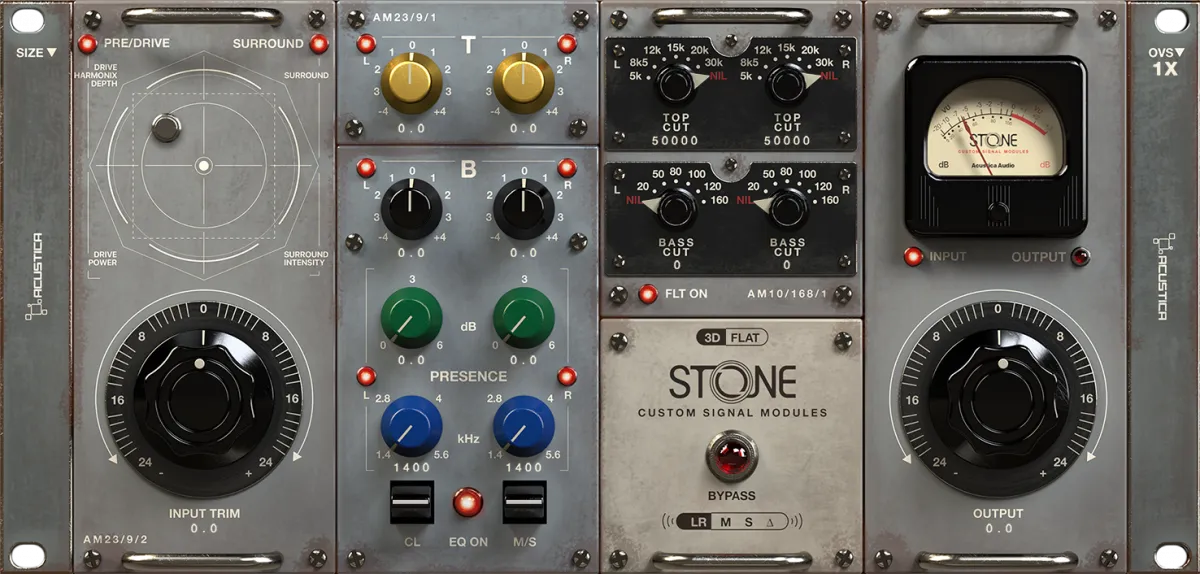
- Magic Morph control blends drive, stereo movement, and spatial depth from one macro control.
- Three-band stereo EQ covers bass, selectable presence shaping, and treble shelf duties.
- High-pass and low-pass filters help trim lows and highs before or after adding character.
- Mid-side processing and channel linking support both focused mono work and wider stereo treatment.
- Switchable 3-D and flat 2-D interfaces let users choose between hardware-style depth and a simpler view.
- Responsive metering and analytical listening options help keep level and tonal changes under control.
Description
STONE is a permanently available Acqua channel strip from Acustica Audio for broad tone shaping on macOS and Windows. It combines input character, harmonic drive, stereo EQ, filtering, metering, and interface switching into one vintage-inspired processor.
The concept is not a straight clone of one console strip. Acustica frames it as a modular signal path inspired by rare British broadcast and studio modules from the 1960s and 1970s, with tone, balance, and character stages designed to interact as one chain.
Its central Magic Morph control gives the plugin its fastest creative workflow. Instead of setting every color stage separately, users can blend drive, stereo movement, and spatial depth in real time, then refine the result with the three-band EQ, high-pass and low-pass filtering, channel linking, and mid-side options.
This is best treated as a finishing color tool rather than a surgical repair processor. Use it on vocals, synths, guitars, drums, buses, or submixes when a source already works but needs more weight, width, movement, or analog-style presence.
Video Preview

Frequently Asked Questions
What kind of processing does STONE combine?
STONE combines input character, harmonic drive, three-band stereo EQ, filtering, metering, and stereo-control features in one Acqua plugin. The Magic Morph control is designed to blend several color and space behaviors quickly instead of treating each stage as a separate utility.
Is STONE a clone of one specific vintage console?
No. Acustica describes it as a custom modular signal system inspired by rare British broadcast and studio modules from the 1960s and 1970s. That makes it closer to a curated tone-shaping chain than a strict single-console emulation.
How do users install STONE?
Acustica distributes STONE through its own product page and Aquarius installation manager. Users should expect an Acustica account and the normal Aquarius workflow rather than a public direct ZIP or installer download.
Where does STONE fit in a mix chain?
It makes the most sense after the core sound is already working, where broad EQ curves, filtering, drive, and stereo movement can add character. It can also work early on individual tracks when the goal is to shape tone before more precise corrective processing.


