
TeAr

Key Features
- Multiple independent arpeggiator engines with separate pattern strings, subdivisions, enable switches, and MIDI output channels
- Text-based pattern language for chord degrees, rests, sustains, random notes, octave movement, pitch offsets, velocity changes, probability, and grouped modifiers
- Scale-aware note generation with selectable roots, modes, pentatonic scales, blues, whole-tone, octatonic, and other modal options
- Follow MIDI In mode for changing the active root note from your keyboard during performance
- Pattern generator popup for fast random and Euclidean rhythm creation inside each arpeggiator lane
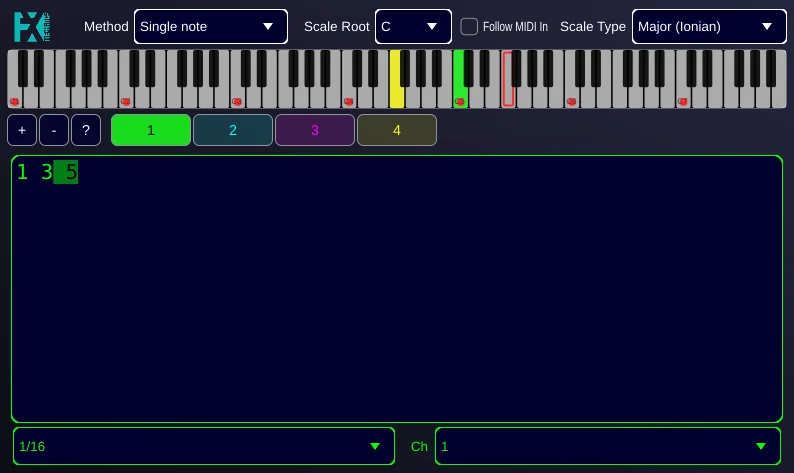
- Real-time visual feedback showing the active scale, root, and currently played notes by engine
- Open-source GitHub release with Windows and Linux VST2/VST3 builds
Description
TeAr is a text-driven MIDI arpeggiator for building layered polyrhythmic patterns from held notes and chords. Instead of offering a single up/down arp lane, it gives each arpeggiator engine its own pattern string, subdivision, enable switch, and MIDI output channel, so one plugin instance can drive several rhythmic voices at once.
The workflow is aimed at producers who like precise pattern writing but still want generative movement. TeAr's language handles rests, sustains, chord degrees, random note choices, pitch changes, velocity levels, octave shifts, probability, and grouped modifiers, while the pattern generator can quickly create random or Euclidean rhythms.
Its scale system keeps output musically constrained while still allowing unusual modal colors. You can pick a root and scale directly, or use Follow MIDI In to change the root from your keyboard during performance, making it useful for evolving synth ostinatos, melodic percussion, Berlin-school sequences, and multi-channel hardware or software setups.
The current release is open source and distributed through GitHub builds for Windows and Linux. The official release notes also note that TeAr is now packaged as an instrument rather than a MIDI effect for broader DAW compatibility, so routing its MIDI output to the instrument you want to hear is part of the setup.
Video Preview


Frequently Asked Questions
Does TeAr generate audio by itself?
No. TeAr is a MIDI generator, so it needs to be routed into a synth, sampler, drum instrument, or external MIDI destination. The 0.2 release changed the plugin packaging to an instrument for better host compatibility, but its purpose is still to output MIDI.
What makes TeAr different from a normal arpeggiator?
TeAr is built around several independent arpeggiator engines rather than one pattern lane. Each engine can use its own rhythm, subdivision, pattern language, and MIDI channel, which makes it better suited to polyrhythmic and multi-part phrases.
How does the text pattern system work?
Patterns are written with compact commands for chord degrees, rests, sustains, octave shifts, velocity, pitch offsets, probability, random notes, and grouped modifiers. This lets you describe detailed MIDI behavior in a short string instead of drawing every step in a grid.
Can TeAr stay in key while generating complex patterns?
Yes. TeAr is scale-aware, with a selectable root and a large scale library covering common modes plus pentatonic, blues, whole-tone, octatonic, harmonic minor, melodic minor, and other options. Follow MIDI In can also update the root from incoming keyboard notes.


