
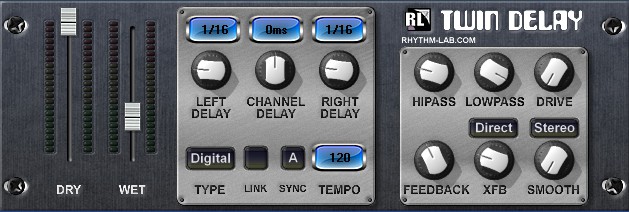
Twin Delay
Key Features
- Four delay algorithms: one digital engine and three distinct tape emulation modes for analog-style warmth and saturation
- Cross-feedback routing for ping-pong delay patterns with adjustable feedback intensity
- High-pass and low-pass filters with tube drive emulation to shape the delay character from dark and warm to bright and aggressive
- Three sync modes (auto host sync, millisecond timing, manual BPM) for precise tempo-locked or free-running echoes
- Mono/stereo smooth function for blending between center-focused repeats and wide stereo delay imaging
- Over 65 built-in presets covering slapback, ambient, rhythmic, flanger, and experimental delay effects
Description
Twin Delay is a dual-engine delay plugin from Rhythm Lab that combines one digital algorithm with three original tape emulation algorithms. It covers standard echo effects alongside more experimental territory, including flanger-style sweeps and metallic resonances.
The tape algorithms are the standout feature, modeled to recreate the warm degradation and pitch drift of analog tape machines. These modes excel at producing the saturated, self-oscillating echoes that define dub, dub techno, and dubstep production styles.
Beyond basic delay duties, the plugin includes high-pass and low-pass filters with tube drive emulation for shaping the feedback character. Cross-feedback routing enables ping-pong patterns, while three sync modes (automatic host sync, millisecond timing, and manual BPM entry) provide flexible tempo control.
A mono/stereo smooth function lets you blend between focused center-channel repeats and wide stereo imaging. The plugin ships with over 65 presets covering everything from subtle slapback echoes to sprawling ambient textures and aggressive rhythmic patterns.
Built with Delphi and Assembler, Twin Delay runs efficiently with minimal CPU overhead, typically staying below 1% usage even on modest systems.
Video Preview

Frequently Asked Questions
Can Twin Delay produce flanger and metalizer effects?
Yes. By using very short delay times and adjusting the feedback, Twin Delay can create flanger-style sweeps and metallic resonant effects. These modulation-like sounds go well beyond standard echo territory and are useful for experimental and IDM production.
What is the difference between the digital and tape algorithms?
The digital algorithm produces clean, precise repeats with no coloration, while the three tape algorithms introduce analog-style warmth, pitch drift, and subtle saturation on each repeat. The tape modes are designed specifically for dub and experimental genres where the delay character is as important as the timing.
How does the cross-feedback function work?
Cross-feedback routes the output of one delay channel into the input of the other, creating ping-pong patterns that bounce between left and right. Combined with the stereo smooth control, this lets you dial in everything from tight centered echoes to wide bouncing delay patterns.


