
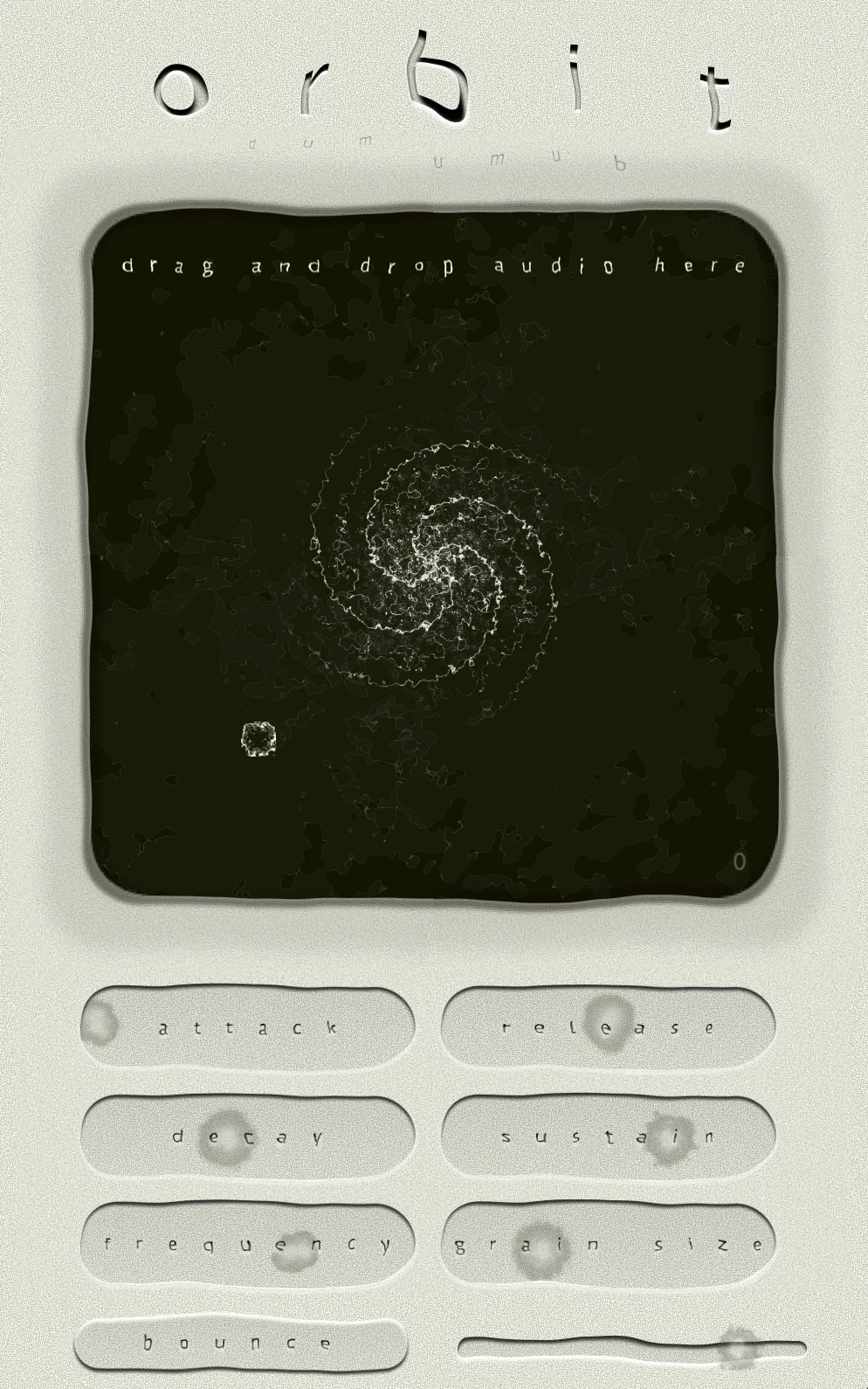
Orbit by Dumumub
Key Features
- Gravity-based granular synthesis engine built around orbiting particles, masses, and emitters
- Visual sound-design workflow for creating evolving pads, ambient textures, and unpredictable motion
- Works especially well with long tones and field recordings that can be pulled into moving grain clouds
- Controls reported by BPB include initial emission direction, mass size, ADSR, Frequency, and Grain Size
- Official downloads are exposed for macOS, Windows, and Linux through Dumumub's Firebase download function
- Available in AU, VST3, CLAP, and standalone formats according to BPB's product coverage
Description
Orbit by Dumumub is a gravity-based granular synthesizer for shaping audio into moving clouds of grains. Instead of presenting granular playback as a static texture generator, it uses a physics-style interface where particles orbit, drift, and react around masses and emitters.
The official Dumumub site describes Orbit as a granular synth built around simulated gravity, with sound particles that feel alive and unpredictable. That makes it a natural fit for long tones, field recordings, ambient beds, and source material that benefits from slow movement rather than tight rhythmic slicing.
The workflow is visual and experimental: add masses and emitters, steer the initial particle direction, then refine the result with controls such as ADSR, frequency, and grain size. BPB's hands-on coverage reported that Orbit installed and launched cleanly on macOS, while noting that the developer's other two plugins were less reliable in that test setup.
As checked on June 29, 2026, Dumumub still lists Orbit on its official site with macOS, Windows, and Linux download buttons, and the download function resolves to working ZIP files for all three platforms. The site metadata also prices Dumumub's audio plugins at 0 USD, with no coupon, countdown, or limited-time wording found.
Frequently Asked Questions
What makes Orbit different from a normal granular synth?
Orbit centers the granular engine around a gravity simulation. Audio particles can orbit and drift around masses, so the movement is part of the instrument rather than just an LFO or random modulation layer.
What source material works best in Orbit?
The official description points to long tones and field recordings as especially effective sources. Those inputs give the particle motion enough sustained material to turn into evolving pads, atmospheres, and unpredictable textures.
Does Orbit cover all desktop platforms?
Yes. The current Dumumub site exposes separate download filenames for macOS, Windows, and Linux.
Are Dumumub's other plugins part of this product page?
No. The BPB source article also mentions Dumumub 0000003 and 0000004, which are separate products.


