
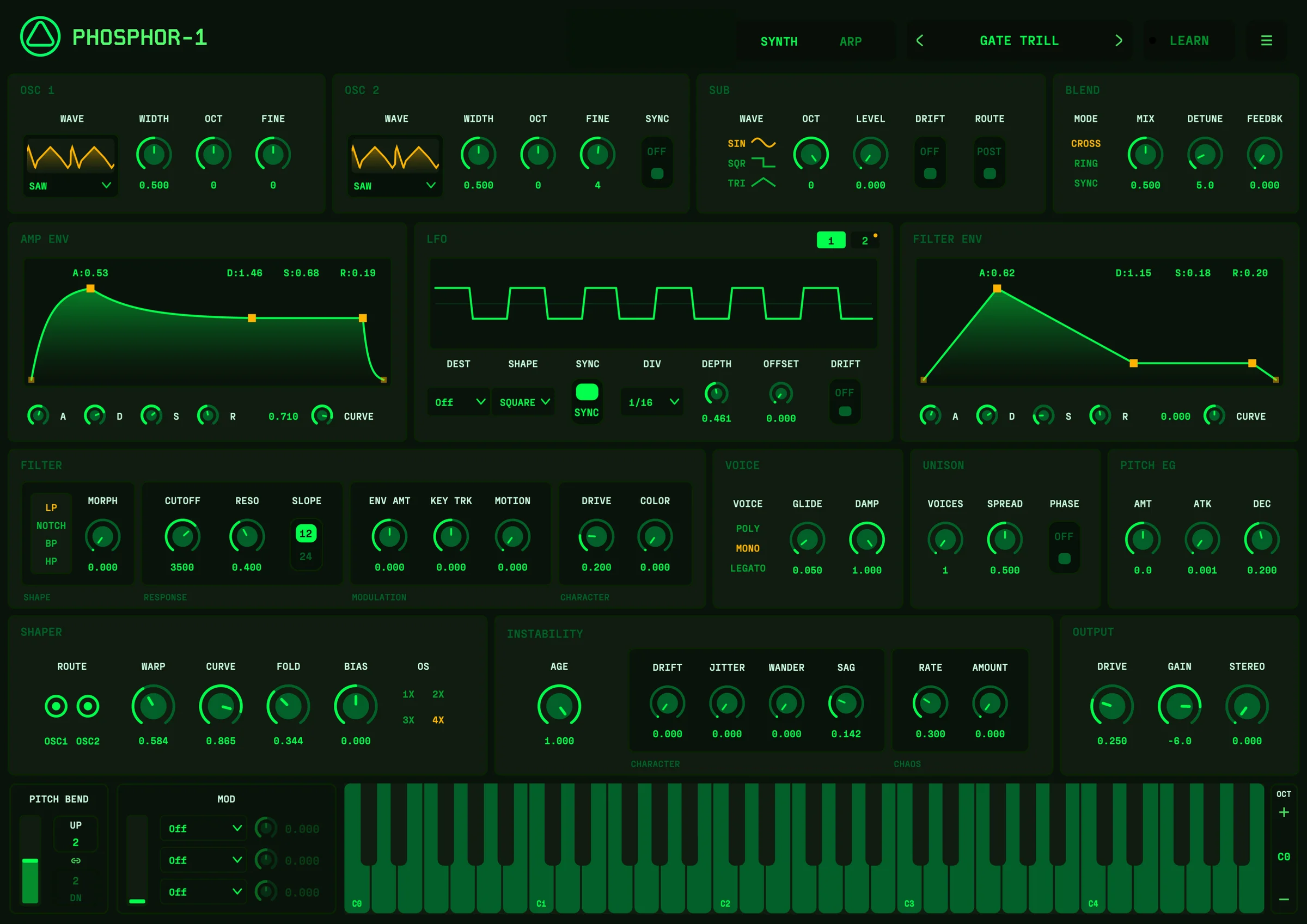
OA-Phosphor-1
Key Features
- AGE macro links drift, jitter, wander, and sag across pitch, filter, level, and pulse-width behavior
- Lorenz-inspired chaos modulation adds evolving motion that can stay subtle or push patches into unstable territory
- Per-voice drift, jitter, chaos, and noise on chords and unison since version 1.2, so stacked voices move independently
- Two oscillators plus a dedicated sub oscillator support cross-modulation, ring modulation, hard-sync blending, and pre or post filter sub routing
- Morphing multimode filter sweeps continuously through low-pass, notch, band-pass, and high-pass responses at a 12 or 24 dB per octave slope
- Wavefolding shaper provides warp, curve, fold, and bias controls with up to 4x oversampling
- Generative arpeggiator includes groove, glitch, per-step probability, ties, rests, octave movement, hold, and multiple pattern modes
- Real stereo width control, draggable amp and filter envelope editors, and live oscillator waveform displays added in version 1.2
- Built-in help mode and a factory bank the developer puts at 111 presets
Description
OA-Phosphor-1 is a free virtual analog synth for macOS, Windows, and Linux built around controllable instability, so it can behave like a clean subtractive instrument or an aging circuit that drifts under your fingers. Its central AGE macro ties pitch, filter, level, and shape movement together, with a Lorenz-style chaos source adding motion that feels animated without becoming random noise.
The synth covers normal basses, pads, plucks, and arps, but its personality is strongest when you want tape-worn wobble, sagging pitch, and hazy electronic texture. Two oscillators plus a sub feed cross-mod, ring-mod, sync, wavefolding, and a morphing multimode filter with a 12 or 24 dB per octave slope, giving the simple analog layout enough bite for darker sound design.
The generative arpeggiator is a practical reason to try it beyond the instability engine. Per-step probability, groove, glitch, ties, rests, octave movement, hold, and pattern modes let the instrument create shifting phrases without turning into a full sequencer.
Version 1.2, released in September 2026, rebuilt the interface and added a real stereo width control, per-voice drift, jitter, and chaos on chords and unison, pre or post filter sub routing, draggable envelope editors with attack up to 10 seconds and release up to 15 seconds, and a five-octave keyboard. The Windows VST3 build is out alongside AU and VST3 on macOS 10.13 or later, plus a community-tested Linux VST3 build. The developer reports 111 factory presets, and the download is free from oa-labs.com after entering an email address.
Video Preview

Frequently Asked Questions
What makes OA-Phosphor-1 different from a normal virtual analog synth?
It is built around an AGE control that changes several instability behaviors together instead of asking you to patch every drift source manually. That makes it useful for moving from a clean analog patch into pitch sag, filter motion, and warped lo-fi texture with one main performance control.
Can OA-Phosphor-1 make regular subtractive synth sounds?
Yes. The official and KVR descriptions both frame it as a capable virtual analog synth at low AGE settings, with oscillators, a sub oscillator, envelopes, LFOs, filter, unison, glide, and normal poly/mono/legato modes.
Is the arpeggiator only for random glitch effects?
No. The arpeggiator includes performance controls such as groove, swing-style timing behavior, octave movement, ties, rests, per-step probability, and multiple pattern modes, so it can create controlled phrases as well as more broken or generative motion.
Is there a Windows version?
Yes. Since version 1.2 in September 2026, OA-Phosphor-1 ships as a VST3 for Windows alongside AU and VST3 on macOS 10.13 or later. There is also a community-tested Linux VST3 build. AAX for Pro Tools is not supported yet, and the developer runs a waitlist for it.
What changed in OA-Phosphor-1 version 1.2?
The 1.2 update rebuilt the interface and added a stereo width control, a 12 or 24 dB per octave filter slope, pre or post filter sub routing, independent pitch-bend ranges, arp hold, much longer envelopes, and a five-octave keyboard. Chords and unison now get per-voice drift, jitter, chaos, and noise. The developer notes that some presets sound different on purpose and that envelope-time automation lanes in projects saved before 1.2 will land in a different place.


